Tutorials#
Numbered, deeply-narrated, multi-step walkthroughs that take a
new user from an empty Model to a
designed structure. Each tutorial builds on concepts from the
prior — modelled on the deal.II step-1 … step-N family
that has trained two decades of finite-element practitioners.
The Tutorials live in the same gallery infrastructure as the focused recipe Post-processing examples, so every line of code runs on every documentation build — nothing in this section is allowed to drift out of sync with the library.
Where Tutorials differ from the focused gallery examples:
Prose-rich. Each step has design rationale, a recap of the FEM theory it exercises, and commentary on the result — not just a thin caption above the code.
End-to-end. Tutorials cover the complete workflow from geometry definition to a defensible engineering conclusion (mesh refinement, allowable check, design iteration).
Sequential. Tutorials assume you’ve worked the prior ones; they don’t re-explain what was already taught.
Cross-linked. Each tutorial points back to the relevant theory chapters in Reference and the focused gallery recipes that demonstrate the same APIs in isolation.
If you want a 30-line snippet of one specific API, browse the Examples gallery instead. Tutorials are for learning the workflow; the gallery is for copy-paste recipes.
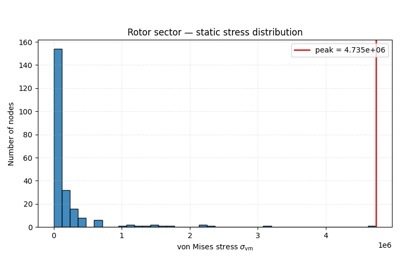
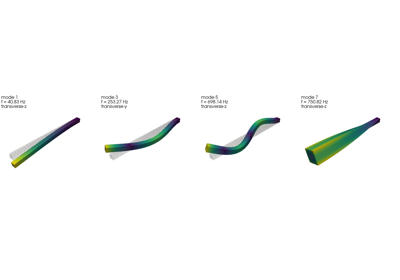
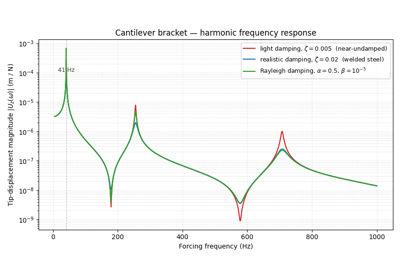
Tutorial 4 — Harmonic frequency response of a cantilever bracket
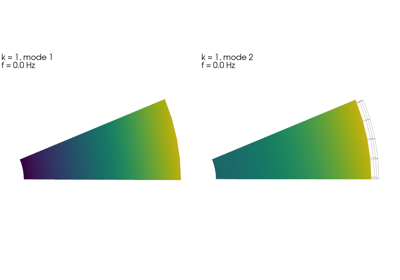
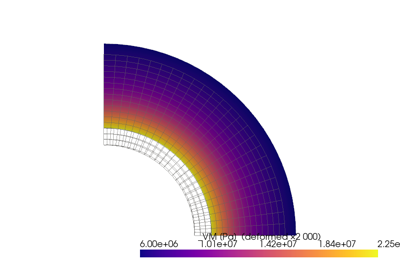
Tutorial 3 — Pressure-vessel design-by-analysis (Lamé thick cylinder)

Tutorial 1 — Cantilever beam under combined loading