Note
Go to the end to download the full example code.
HEX8 — elastic-strain post-processing#
Solve a HEX8 flat plate under uniaxial tension and recover the full
6-component elastic-strain tensor on the mesh with
femorph_solver.result.StaticResult.elastic_strain() — element-nodal
strain averaged onto every grid point.
result.elastic_strain(model=m) returns the nodal-averaged Voigt
strain (n_points, 6) (the canonical post-processing output);
elastic_strain_per_element()
returns the per-element dict {elem_num: (n_nodes_in_elem, 6)} for
verification workflows that need raw element-by-element values. Strain
is computed at each element’s own nodes as
\(\varepsilon(\xi_\text{node}) = B(\xi_\text{node})\cdot u_e\)
— no RST round-trip, no disk write.
from __future__ import annotations

import numpy as np
import pyvista as pv
from vtkmodules.util.vtkConstants import VTK_HEXAHEDRON

import femorph_solver
from femorph_solver import ELEMENTS
Problem setup#
A 1 m × 0.4 m × 0.05 m steel plate meshed as a 20 × 8 × 1 HEX8
brick (160 elements). The x = 0 face is held in UX (symmetry),
a single pin at the origin kills the UY / UZ rigid-body modes,
and the x = LX face is pulled by a total force F split over
its corner nodes.
E = 2.1e11  # Pa
NU = 0.30
RHO = 7850.0
LX, LY, LZ = 1.0, 0.4, 0.05
NX, NY, NZ = 20, 8, 1
F_TOTAL = 1.0e5  # N

xs = np.linspace(0.0, LX, NX + 1)
ys = np.linspace(0.0, LY, NY + 1)
zs = np.linspace(0.0, LZ, NZ + 1)
xx, yy, zz = np.meshgrid(xs, ys, zs, indexing="ij")
points = np.stack([xx.ravel(), yy.ravel(), zz.ravel()], axis=1)


# Hex connectivity in VTK_HEXAHEDRON order (0-based VTK indices).
def _node_idx(i: int, j: int, k: int) -> int:
    return (i * (NY + 1) + j) * (NZ + 1) + k


cells_flat: list[int] = []
for i in range(NX):
    for j in range(NY):
        for k in range(NZ):
            cells_flat.extend(
                [
                    8,
                    _node_idx(i, j, k),
                    _node_idx(i + 1, j, k),
                    _node_idx(i + 1, j + 1, k),
                    _node_idx(i, j + 1, k),
                    _node_idx(i, j, k + 1),
                    _node_idx(i + 1, j, k + 1),
                    _node_idx(i + 1, j + 1, k + 1),
                    _node_idx(i, j + 1, k + 1),
                ]
            )

n_cells = NX * NY * NZ
cell_types = np.full(n_cells, VTK_HEXAHEDRON, dtype=np.uint8)
grid = pv.UnstructuredGrid(np.asarray(cells_flat, dtype=np.int64), cell_types, points)
Build the femorph-solver model#
m = femorph_solver.Model.from_grid(grid)
m.assign(ELEMENTS.HEX8, material={"EX": E, "PRXY": NU, "DENS": RHO})

node_nums = np.asarray(m.grid.point_data["ansys_node_num"])
pts = np.asarray(m.grid.points)

# Symmetry BC: x=0 face clamped in UX; single pin at the origin in UY/UZ.
x0_nodes = node_nums[pts[:, 0] < 1e-9].tolist()
m.fix(nodes=x0_nodes, dof="UX")
origin_nodes = node_nums[(pts[:, 0] < 1e-9) & (pts[:, 1] < 1e-9) & (pts[:, 2] < 1e-9)].tolist()
m.fix(nodes=origin_nodes, dof="UY")
m.fix(nodes=origin_nodes, dof="UZ")

# Traction on x=LX face: split F_TOTAL over its nodes.
x_end_nodes = node_nums[pts[:, 0] > LX - 1e-9].tolist()
fx_each = F_TOTAL / len(x_end_nodes)
for nn in x_end_nodes:
    m.apply_force(int(nn), fx=fx_each)
Static solve#
res = m.solve_static()
Recover elastic strain#
Default call returns nodal-averaged strain of shape (n_points, 6):
columns are [εxx, εyy, εzz, γxy, γyz, γxz] with engineering
shears (canonical Voigt strain-recovery output).
eps = res.elastic_strain(model=m)
print(f"eps shape: {eps.shape}")

# Analytical: uniform σxx = F_TOTAL / (LY · LZ), εxx = σ / E,
# εyy = εzz = -ν · εxx.
sigma_xx = F_TOTAL / (LY * LZ)
eps_xx_expected = sigma_xx / E
eps_yy_expected = -NU * eps_xx_expected
print(f"εxx expected = {eps_xx_expected:.3e}")
print(f"εxx recovered (mean over nodes) = {eps[:, 0].mean():.3e}")
print(f"εyy recovered (mean)            = {eps[:, 1].mean():.3e}")
print(f"εyy analytical                  = {eps_yy_expected:.3e}")
eps shape: (378, 6)
εxx expected = 2.381e-05
εxx recovered (mean over nodes) = 2.416e-05
εyy recovered (mean)            = -7.365e-06
εyy analytical                  = -7.143e-06
Per-element arrays keyed by element number — useful when you want to see jumps at element boundaries or compute element-wise strain norms.
per_elem = res.elastic_strain_per_element(model=m)
first_elem = next(iter(per_elem))
print(
    f"per-element dict has {len(per_elem)} elements; "
    f"first key = {first_elem}, "
    f"strain block shape = {per_elem[first_elem].shape}"
)
per-element dict has 160 elements; first key = 1, strain block shape = (8, 6)
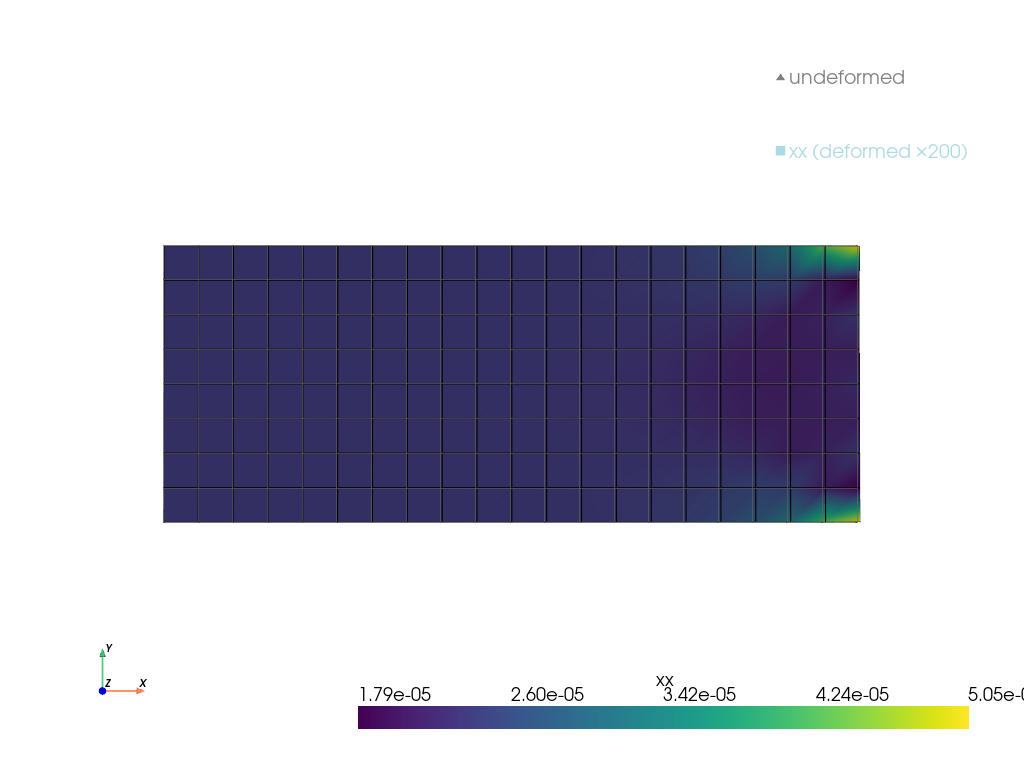
Visualise εxx on the deformed mesh#
femorph_solver.io.static_result_to_grid() scatters the per-node
displacement onto (n_points, 3) UX/UY/UZ point data in one call —
no hand-rolled dof-map loop required. elastic_strain is already
indexed in grid-point order so εxx drops straight onto the grid.
grid = femorph_solver.io.static_result_to_grid(m, res)
grid.point_data["eps_xx"] = eps[:, 0]

warped = grid.warp_by_vector("displacement", factor=200.0)

plotter = pv.Plotter(off_screen=True)
plotter.add_mesh(
    grid,
    style="wireframe",
    color="gray",
    line_width=1,
    opacity=0.4,
    label="undeformed",
)
plotter.add_mesh(
    warped,
    scalars="eps_xx",
    show_edges=True,
    cmap="viridis",
    scalar_bar_args={"title": "εxx"},
    label="εxx (deformed ×200)",
)
plotter.add_legend()
plotter.add_axes()
plotter.view_xy()
plotter.show()
Total running time of the script: (0 minutes 0.249 seconds)