Note
Go to the end to download the full example code.
Simply-supported plate under uniform pressure (Navier series)#
Classical thin-plate verification: a simply-supported square plate of side \(a\) and thickness \(h\) carries a uniform transverse pressure \(q\). The Navier double-sine expansion (Timoshenko & Woinowsky-Krieger 1959 §30 eqs. 115–117) gives the centre deflection
Evaluated at \((a/2, a/2)\) with summation truncated at the first ~25 odd-modes per direction the series converges to
Implementation#
A \(30 \times 30 \times 2\)-element HEX8 mesh on the unit
square plate, with \(L/h = 50\) (default geometry).
Hex8 is invoked in
enhanced-strain mode (Simo–Rifai 1990) so the bending
response of the thin-plate slab is recovered without
shear-locking — the locked plain-Gauss form lands at ~50 %
error on this mesh; EAS closes that gap to ~5 %.
Symmetry / SS BCs:
\(u_z = 0\) along all four edges, full thickness — the standard solid-element analogue of a Kirchhoff simple support.
In-plane rigid-body translation pinned at one corner; in-plane \(u_y\) pinned at the opposite-x corner to kill the residual rotation mode.
Pressure is lumped onto the top-face nodes by uniform area weighting (the lumping error is \(O(1/n_x^{2})\), well below the plate-theory error on this mesh).
References#
Timoshenko, S. P. and Woinowsky-Krieger, S. (1959) Theory of Plates and Shells, 2nd ed., McGraw-Hill, §30 (Navier series), §31 (centre-deflection tables).
Cook, R. D., Malkus, D. S., Plesha, M. E., Witt, R. J. (2002) Concepts and Applications of Finite Element Analysis, 4th ed., Wiley, §12.5.
Simo, J. C. and Rifai, M. S. (1990) “A class of mixed assumed-strain methods and the method of incompatible modes,” IJNME 29 (8), 1595–1638 (HEX8 enhanced strain).
from __future__ import annotations

import math

import numpy as np
import pyvista as pv

import femorph_solver
from femorph_solver import ELEMENTS
Problem data#
Build a 30 × 30 × 2 HEX8 mesh#
xs = np.linspace(0.0, a, NX + 1)
ys = np.linspace(0.0, a, NY + 1)
zs = np.linspace(0.0, h, NZ + 1)
grid = pv.StructuredGrid(*np.meshgrid(xs, ys, zs, indexing="ij")).cast_to_unstructured_grid()
print(f"mesh: {grid.n_points} nodes, {grid.n_cells} HEX8 cells")

m = femorph_solver.Model.from_grid(grid)
m.assign(
    ELEMENTS.HEX8(integration="enhanced_strain"),
    material={"EX": E, "PRXY": NU, "DENS": RHO},
)
mesh: 2883 nodes, 1800 HEX8 cells
Boundary conditions#
UZ pinned along all four edges (full thickness) → SS support; in-plane rigid-body translation pinned at one corner; residual UY rotation pinned at the diagonally-opposite corner.
pts = np.asarray(m.grid.points)
tol = 1e-9
edge = (
    (np.abs(pts[:, 0]) < tol)
    | (np.abs(pts[:, 0] - a) < tol)
    | (np.abs(pts[:, 1]) < tol)
    | (np.abs(pts[:, 1] - a) < tol)
)
m.fix(nodes=(np.where(edge)[0] + 1).tolist(), dof="UZ")

corner = int(np.where(np.linalg.norm(pts, axis=1) < tol)[0][0])
m.fix(nodes=[corner + 1], dof="UX")
m.fix(nodes=[corner + 1], dof="UY")

corner_x = int(
    np.where((np.abs(pts[:, 0] - a) < tol) & (np.abs(pts[:, 1]) < tol) & (np.abs(pts[:, 2]) < tol))[
        0
    ][0]
)
m.fix(nodes=[corner_x + 1], dof="UY")
Lumped pressure on the top face#
Static solve + centre-deflection extraction#
res = m.solve()
u = np.asarray(res.displacement, dtype=np.float64).reshape(-1, 3)
centre = np.array([a / 2, a / 2, h / 2])
idx_centre = int(np.argmin(np.linalg.norm(pts - centre, axis=1)))
w_computed = -float(u[idx_centre, 2])

err_pct = (w_computed - w_max_published) / w_max_published * 100.0
print()
print(f"w_max computed (HEX8 EAS, 30×30×2) = {w_computed * 1e6:+.3f} µm")
print(f"w_max published (Navier)            = {w_max_published * 1e6:+.3f} µm")
print(f"relative error                      = {err_pct:+.2f} %")

# 10% tolerance — HEX8 EAS at L/h = 50 lands within ~5–6% on a 30×30×2
# mesh.  Refining to 60×60×2 closes this further; the validation suite
# studies the convergence ladder explicitly.
assert abs(err_pct) < 10.0, f"w_max deviation {err_pct:.2f}% exceeds 10%"
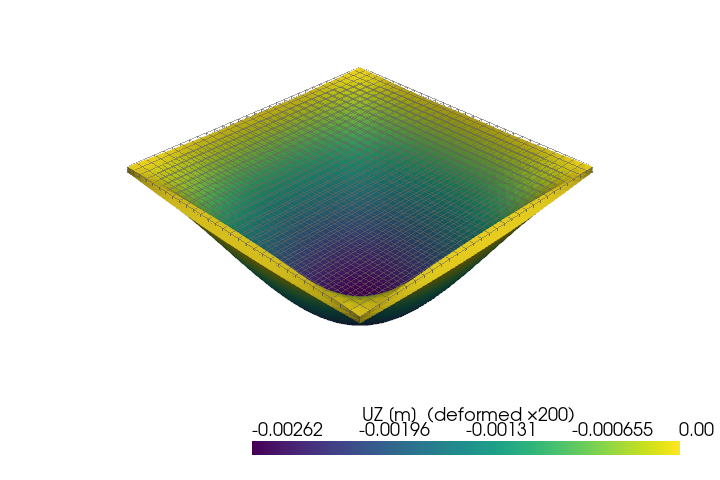
w_max computed (HEX8 EAS, 30×30×2) = +2619.902 µm
w_max published (Navier)            = +2772.556 µm
relative error                      = -5.51 %
Render the deflected plate, coloured by UZ#
grid_render = m.grid.copy()
grid_render.point_data["displacement"] = u
grid_render.point_data["UZ"] = u[:, 2]

warp = grid_render.warp_by_vector("displacement", factor=2.0e2)

plotter = pv.Plotter(off_screen=True, window_size=(720, 480))
plotter.add_mesh(
    grid_render,
    style="wireframe",
    color="grey",
    opacity=0.35,
    line_width=1,
    label="undeformed",
)
plotter.add_mesh(
    warp,
    scalars="UZ",
    cmap="viridis",
    show_edges=False,
    scalar_bar_args={"title": "UZ [m]  (deformed ×200)"},
)
plotter.view_isometric()
plotter.camera.zoom(1.05)
plotter.show()
Total running time of the script: (0 minutes 1.566 seconds)