Note
Go to the end to download the full example code.
Shear-locking demonstration — HEX8 integration variants#
The textbook trap of low-order solid elements: a fully- integrated 8-node trilinear hex (HEX8 with full 2 × 2 × 2 Gauss, no B-bar / enhanced strain) cannot reproduce linear-bending kinematics, because the constant-strain Gauss point at the element centre overstates the bending stiffness (Cook §6.6, §6.13). The result is shear locking: even on a slender cantilever where the Euler-Bernoulli analytical answer is exact, the FE displacement is too small — sometimes by orders of magnitude — and the missing strain energy goes into spurious transverse shear at the Gauss point.
Two practitioner cures, both shipped with femorph-solver’s HEX8 — 8-node trilinear hexahedron:
B-bar volumetric stabilisation (Hughes 1980, default
ELEMENTS.HEX8): averages the volumetric component of the strain field across the element, suppressing the related volumetric locking at \(\nu \to 0.5\) but not the shear locking on its own.Enhanced assumed strain (EAS — Simo–Rifai 1990,
ELEMENTS.HEX8(integration="enhanced_strain")): adds nine static-condensed internal modes that fix bending-mode shear locking exactly. The natural choice for thin-bending solid geometries.
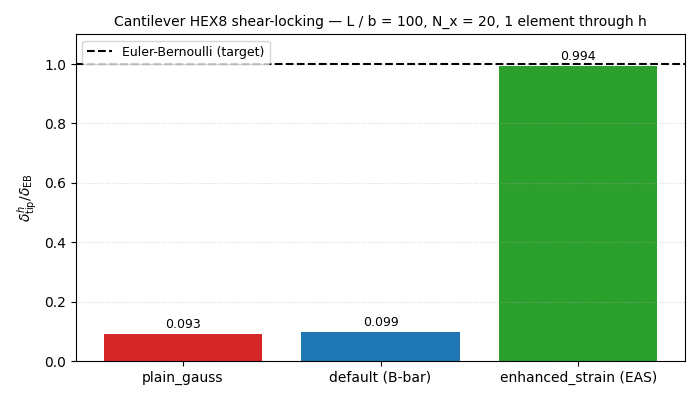
This example solves the same cantilever-tip-load problem with three integration variants side by side and prints the tip- deflection ratio against the Euler-Bernoulli closed form \(\delta = P L^{3} / (3 E I)\):
ELEMENTS.HEX8(integration="plain_gauss")— full 2×2×2 Gauss, no stabilisation (the textbook locking case).ELEMENTS.HEX8— full Gauss + B-bar (default).ELEMENTS.HEX8(integration="enhanced_strain")— EAS.
References#
Cook, R. D., Malkus, D. S., Plesha, M. E., Witt, R. J. (2002) Concepts and Applications of Finite Element Analysis, 4th ed., Wiley, §6.6 (volumetric locking), §6.13 (shear locking + EAS), §17.2 (low-order shell cure).
Hughes, T. J. R. (1980) “Generalization of selective integration procedures to anisotropic and nonlinear media,” International Journal for Numerical Methods in Engineering 15 (9), 1413–1418 (B-bar).
Simo, J. C. and Rifai, M. S. (1990) “A class of mixed assumed strain methods and the method of incompatible modes,” International Journal for Numerical Methods in Engineering 29 (8), 1595–1638 (EAS).
Bathe, K.-J. (2014) Finite Element Procedures, 2nd ed., §5.3.4 (incompatible modes / EAS).
Belytschko, T., Liu, W. K., Moran, B. and Elkhodary, K. (2014) Nonlinear Finite Elements for Continua and Structures, 2nd ed., Wiley, §8.4 (locking modes).
from __future__ import annotations

import matplotlib.pyplot as plt
import numpy as np
import pyvista as pv

import femorph_solver
from femorph_solver import ELEMENTS
Problem data#
E = 2.0e11
NU = 0.3
RHO = 7850.0
b = 0.01  # cross-section side; L / b = 100 → very slender → severe locking
A = b * b
I = b**4 / 12.0  # noqa: E741
L = 1.0
P_TOTAL = -100.0  # N (small load → linear regime)

NX, NY, NZ = 20, 1, 1  # 20 elements axial, 1 through each thickness

delta_eb = P_TOTAL * L**3 / (3.0 * E * I)
print(f"L / b = {L / b:.0f} (slender)")
print(f"δ_EB = P L^3 / (3 EI) = {delta_eb * 1e6:.3f} µm")


def run_with_integration(label: str, kwargs: dict) -> tuple[float, float]:
    """Solve the same cantilever with the given HEX8 spec; return
    (UY tip mid-surface, ratio_to_EB)."""
    xs = np.linspace(0.0, L, NX + 1)
    ys = np.linspace(0.0, b, NY + 1)
    zs = np.linspace(0.0, b, NZ + 1)
    grid = pv.StructuredGrid(*np.meshgrid(xs, ys, zs, indexing="ij")).cast_to_unstructured_grid()

    m = femorph_solver.Model.from_grid(grid)
    if kwargs:
        m.assign(ELEMENTS.HEX8(**kwargs), material={"EX": E, "PRXY": NU, "DENS": RHO})
    else:
        m.assign(ELEMENTS.HEX8, material={"EX": E, "PRXY": NU, "DENS": RHO})

    pts = np.asarray(m.grid.points)
    node_nums = np.asarray(m.grid.point_data["ansys_node_num"])
    fixed = node_nums[pts[:, 0] < 1e-9]
    m.fix(nodes=fixed.tolist(), dof="ALL")
    tip_nodes = node_nums[pts[:, 0] > L - 1e-9]
    fz_per = P_TOTAL / len(tip_nodes)
    for nn in tip_nodes:
        m.apply_force(int(nn), fy=fz_per)

    res = m.solve()
    g = femorph_solver.io.static_result_to_grid(m, res)
    pts_g = np.asarray(g.points)
    tip_mask = pts_g[:, 0] > L - 1e-9
    uy_tip = float(g.point_data["displacement"][tip_mask, 1].mean())
    return uy_tip, uy_tip / delta_eb
L / b = 100 (slender)
δ_EB = P L^3 / (3 EI) = -200000.000 µm
Three integration variants — side by side#
variants = [
    ("plain_gauss", {"integration": "plain_gauss"}, "#d62728"),
    ("default (B-bar)", {}, "#1f77b4"),
    ("enhanced_strain (EAS)", {"integration": "enhanced_strain"}, "#2ca02c"),
]
results: list[tuple[str, float, float, str]] = []

print()
print(f"{'integration':>26}  {'UY_tip [µm]':>12}  {'UY / δ_EB':>10}")
print(f"{'-' * 26:>26}  {'-' * 12:>12}  {'-' * 10:>10}")
for label, kwargs, colour in variants:
    uy, ratio = run_with_integration(label, kwargs)
    results.append((label, uy, ratio, colour))
    print(f"{label:>26}  {uy * 1e6:12.4f}  {ratio:10.6f}")
               integration   UY_tip [µm]   UY / δ_EB
--------------------------  ------------  ----------
               plain_gauss   -18558.7369    0.092794
           default (B-bar)   -19885.0662    0.099425
     enhanced_strain (EAS)  -198878.0752    0.994390
Verify the textbook ordering#
The locked plain-Gauss solution must underpredict the Euler-Bernoulli reference on a slender beam (textbook expectation: locks to ~10–30 % of the analytical answer at L/b = 100, NX = 20 with one element through the thickness). B-bar is not a shear-locking cure — it cures volumetric locking only — so it should give the same locked deflection as plain Gauss in this benchmark. Only EAS recovers the bending mode.
Render the deflection-ratio comparison#
labels = [r[0] for r in results]
ratios_values = [r[2] for r in results]
colours = [r[3] for r in results]

fig, ax = plt.subplots(1, 1, figsize=(7.0, 4.0))
bars = ax.bar(labels, ratios_values, color=colours)
ax.axhline(1.0, linestyle="--", color="black", lw=1.5, label="Euler-Bernoulli (target)")
ax.set_ylabel(r"$\delta^{h}_{\mathrm{tip}} / \delta_{\mathrm{EB}}$")
ax.set_title(
    f"Cantilever HEX8 shear-locking — L / b = {L / b:.0f}, N_x = {NX}, 1 element through h",
    fontsize=10,
)
ax.set_ylim(0.0, 1.10)
for bar, ratio in zip(bars, ratios_values):
    ax.annotate(
        f"{ratio:.3f}",
        xy=(bar.get_x() + bar.get_width() / 2, ratio),
        xytext=(0, 4),
        textcoords="offset points",
        ha="center",
        fontsize=9,
    )
ax.legend(loc="upper left", fontsize=9)
ax.grid(True, axis="y", ls=":", alpha=0.5)
fig.tight_layout()
fig.show()
Closing note#
print()
print("Take-aways:")
print(
    f"  • plain_gauss    → {ratios['plain_gauss']:.1%} of EB  (locked; spurious shear-strain energy)"
)
print(
    f"  • B-bar default  → {ratios['default (B-bar)']:.1%} of EB  (B-bar cures *volumetric* locking, not shear)"
)
print(
    f"  • EAS variant    → {ratios['enhanced_strain (EAS)']:.1%} of EB  (the right cure for thin-bending solid kernels)"
)
Take-aways:
  • plain_gauss    → 9.3% of EB  (locked; spurious shear-strain energy)
  • B-bar default  → 9.9% of EB  (B-bar cures *volumetric* locking, not shear)
  • EAS variant    → 99.4% of EB  (the right cure for thin-bending solid kernels)
Total running time of the script: (0 minutes 0.121 seconds)