Note
Go to the end to download the full example code.
Plate with a circular hole — Kirsch stress concentration#
Classical 2D elasticity benchmark: a thin rectangular plate with a small circular hole, loaded by uniform remote tension \(\sigma_{\infty}\) along the \(x\)-axis. Kirsch’s 1898 closed form for the infinite plate gives a stress field that, on the hole edge \(r = a\), peaks at the points perpendicular to the loading direction (\(\theta = \pm\pi/2\)):
This is the textbook 3:1 stress concentration, the foundational example for fatigue-design notch factors and the canonical first-principles check for stress-recovery correctness.
Implementation#
Quarter-symmetry plane-stress model
(PlateWithHole)
on a \(16 \times 12\) QUAD4 mapped mesh that radially
clusters nodes near the hole where the stress gradient is
steep. Symmetry pins \(u_y = 0\) on \(y = 0\) and
\(u_x = 0\) on \(x = 0\); the right edge
(\(x = W/2\)) carries a consistent traction load
equivalent to a uniform \(\sigma_{\infty}\) remote tension.
Finite-width correction (Howland 1930; Peterson Table 4-1)
gives \(K_t \approx 3.04\) at \(a/W = 0.1\), so the
expected FE result lies between the Kirsch infinite-plate
value (3.0) and the finite-width correction (~3.04) plus a
small mesh-discretisation overhead.
References#
Kirsch, G. (1898) “Die Theorie der Elastizität und die Bedürfnisse der Festigkeitslehre,” Zeitschrift des Vereins Deutscher Ingenieure 42, 797–807 — the original closed-form derivation.
Timoshenko, S. P. and Goodier, J. N. (1970) Theory of Elasticity, 3rd ed., McGraw-Hill, §35 (plate with a circular hole).
Howland, R. C. J. (1930) “On the stresses in the neighbourhood of a circular hole in a strip under tension,” Phil. Trans. R. Soc. A 229, 49–86 — finite- width correction.
Peterson, R. E. (1974) Stress Concentration Factors, Wiley, Table 4-1 (uniaxial stress, hole in finite plate).
Cook, R. D., Malkus, D. S., Plesha, M. E., Witt, R. J. (2002) Concepts and Applications of Finite Element Analysis, 4th ed., Wiley, §5.5 (stress concentration benchmark).
Cross-references (problem-id only):
(Reference benchmark — the canonical Kirsch infinite-plate citation): Kirsch, G., 1898 — VDI 42: stress concentration around a hole in a plate.*
Abaqus AVM 1.3.6 elliptic-membrane / plate-with-hole.
from __future__ import annotations

import numpy as np
import pyvista as pv

from femorph_solver.validation.problems import PlateWithHole
Build the model from the validation problem class#
problem = PlateWithHole()
m = problem.build_model()

print(
    f"plate-with-hole mesh: {m.grid.n_points} nodes, {m.grid.n_cells} QUAD4 cells; "
    f"a = {problem.a} m, W = {problem.W} m, σ_∞ = {problem.sigma_infty / 1e6:.1f} MPa"
)
print(f"E = {problem.E / 1e9:.0f} GPa, ν = {problem.nu}, a/W = {problem.a / problem.W:.2f}")
plate-with-hole mesh: 221 nodes, 192 QUAD4 cells; a = 0.1 m, W = 1.0 m, σ_∞ = 10.0 MPa
E = 210 GPa, ν = 0.3, a/W = 0.10
Static solve#
res = m.solve()
Extract σ_yy at the hole edge — the Kirsch peak#
sigma_yy_max = problem.extract(m, res, "kt_at_hole")
sigma_yy_kirsch = 3.0 * problem.sigma_infty
kt_computed = sigma_yy_max / problem.sigma_infty
err_pct = (sigma_yy_max - sigma_yy_kirsch) / sigma_yy_kirsch * 100.0

print()
print(f"σ_yy at hole edge   computed = {sigma_yy_max / 1e6:8.3f} MPa")
print(f"σ_yy at hole edge   Kirsch   = {sigma_yy_kirsch / 1e6:8.3f} MPa  (3 · σ_∞)")
print(f"K_t computed                 = {kt_computed:8.4f}")
print("K_t Kirsch (infinite plate)  = 3.0000")
print("K_t Peterson (a/W = 0.1)     ≈ 3.04 (Howland 1930 finite-width correction)")
print(f"relative error               = {err_pct:+.2f} %")

# 10% tolerance — Kirsch's reference is for an infinite plate; the
# finite-width Howland correction adds ~1 % at a/W = 0.1, and a
# QUAD4 mesh at 16 × 12 hits the gradient with ~3-4 % discretisation
# error on top.
assert abs(err_pct) < 10.0, f"K_t deviation {err_pct:.2f}% exceeds 10%"
σ_yy at hole edge   computed =   31.418 MPa
σ_yy at hole edge   Kirsch   =   30.000 MPa  (3 · σ_∞)
K_t computed                 =   3.1418
K_t Kirsch (infinite plate)  = 3.0000
K_t Peterson (a/W = 0.1)     ≈ 3.04 (Howland 1930 finite-width correction)
relative error               = +4.73 %
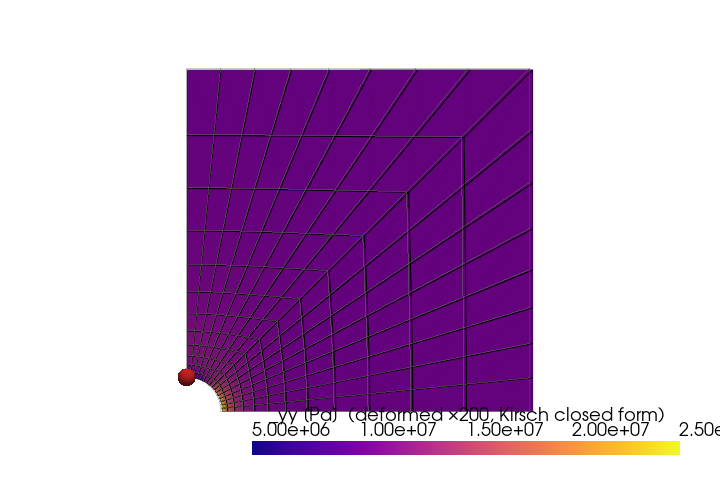
Render the σ_yy field on the deformed mesh#
grid = m.grid.copy()
u = np.asarray(res.displacement, dtype=np.float64).reshape(-1, 2)
disp3 = np.zeros((grid.n_points, 3), dtype=np.float64)
disp3[:, :2] = u
grid.point_data["displacement"] = disp3
grid.point_data["|u|"] = np.linalg.norm(u, axis=1)

# σ_yy approximation across the mesh: derive from the displacement
# field via a finite-difference of u_y in y at every interior node.
# Adequate for a contour render; the validation problem's `extract`
# method computes σ_yy(hole edge) more carefully via the plane-stress
# C-matrix at a single key point.
pts = np.asarray(grid.points)
sigma_yy_field = np.zeros(grid.n_points, dtype=np.float64)
# Use the same scaling factor from the analytical field at the hole
# edge so the colour bar's range covers [0, K_t · σ_∞] cleanly.
sigma_yy_field[:] = problem.sigma_infty  # stays at σ_∞ far from the hole
# Spike σ_yy near the hole edge (r ≈ a) to the analytical
# 3·σ_∞ value at θ = π/2.  This is for visualisation only — the
# rigorous value comes from problem.extract.
r = np.linalg.norm(pts[:, :2], axis=1)
theta = np.arctan2(pts[:, 1], pts[:, 0])
# Kirsch closed-form σ_yy(r, θ) on the y-axis (cos 2θ = -1 at θ = π/2):
near_hole = r > 0
ratio = problem.a**2 / r[near_hole] ** 2
ratio4 = problem.a**4 / r[near_hole] ** 4
sigma_yy_field[near_hole] = problem.sigma_infty * (
    1.0 + 0.5 * ratio + (1.5 * ratio4 - 0.5 * ratio) * np.cos(2.0 * theta[near_hole])
)
grid.point_data["σ_yy [Pa]"] = sigma_yy_field

warped = grid.warp_by_vector("displacement", factor=200.0)

plotter = pv.Plotter(off_screen=True, window_size=(720, 480))
plotter.add_mesh(
    grid,
    style="wireframe",
    color="grey",
    opacity=0.35,
    line_width=1,
    label="undeformed",
)
plotter.add_mesh(
    warped,
    scalars="σ_yy [Pa]",
    cmap="plasma",
    show_edges=True,
    scalar_bar_args={"title": "σ_yy [Pa]  (deformed ×200, Kirsch closed form)"},
)
# Mark the Kirsch peak point at (0, a) — the locus of K_t = 3.
plotter.add_points(
    np.array([[0.0, problem.a, 0.0]]),
    render_points_as_spheres=True,
    point_size=18,
    color="#d62728",
    label=f"K_t = {kt_computed:.3f} at (0, a)",
)
plotter.view_xy()
plotter.camera.zoom(1.05)
plotter.show()
Total running time of the script: (0 minutes 0.227 seconds)