Note
Go to the end to download the full example code.
Simply-supported plate — first transverse bending mode#
Classical thin-plate eigenvalue problem. A simply-supported square plate of side \(a\) and thickness \(h\) has Kirchhoff natural frequencies (Timoshenko & Woinowsky-Krieger 1959 §63 eq. 151)
so the (1, 1) fundamental of a square plate \(a = b\) is
Implementation#
A 30 × 30 × 2 HEX8 enhanced-strain (Simo–Rifai 1990) mesh on the unit square plate at \(L/h = 100\). Simply-supported boundary conditions pin \(u_z = 0\) along all four edges through the full thickness; in-plane rigid-body translation is removed at one corner. The mode-shape filter selects the first mode whose UZ root-mean-square dominates the in-plane components (i.e. the (1, 1) bending mode), in case any spurious in-plane modes precede it on a coarse mesh.
Modal analysis runs through Model.modal_solve() (ARPACK
shift-invert via femorph_solver.solvers.modal).
References#
Timoshenko, S. P. and Woinowsky-Krieger, S. (1959) Theory of Plates and Shells, 2nd ed., McGraw-Hill, §63 eq. 151 (rectangular plate eigenfrequencies).
Cook, R. D., Malkus, D. S., Plesha, M. E., Witt, R. J. (2002) Concepts and Applications of Finite Element Analysis, 4th ed., Wiley, §12.5.
Simo, J. C. and Rifai, M. S. (1990) “A class of mixed assumed-strain methods …” IJNME 29 (8), 1595–1638.
from __future__ import annotations

import math

import numpy as np
import pyvista as pv

import femorph_solver
from femorph_solver import ELEMENTS
Problem data#
E = 2.0e11  # Pa (steel)
NU = 0.3
RHO = 7850.0  # kg/m^3
a = 1.0  # plate edge length [m]
h = 0.01  # thickness [m]; L/h = 100

NX = NY = 30
NZ = 2

D = E * h**3 / (12.0 * (1.0 - NU**2))
f11_published = (math.pi / 2.0) * (1.0 / a**2 + 1.0 / a**2) * math.sqrt(D / (RHO * h))
print(f"a = {a} m, h = {h} m, L/h = {a / h:.0f}")
print(f"E = {E / 1e9:.0f} GPa, ν = {NU}, ρ = {RHO} kg/m^3, D = {D:.3e} N m")
print(f"f_11 published (Timoshenko §63)   = {f11_published:.4f} Hz")
a = 1.0 m, h = 0.01 m, L/h = 100
E = 200 GPa, ν = 0.3, ρ = 7850.0 kg/m^3, D = 1.832e+04 N m
f_11 published (Timoshenko §63)   = 47.9865 Hz
Build a 30 × 30 × 2 HEX8 mesh#
xs = np.linspace(0.0, a, NX + 1)
ys = np.linspace(0.0, a, NY + 1)
zs = np.linspace(0.0, h, NZ + 1)
grid = pv.StructuredGrid(*np.meshgrid(xs, ys, zs, indexing="ij")).cast_to_unstructured_grid()
print(f"mesh: {grid.n_points} nodes, {grid.n_cells} HEX8 cells")

m = femorph_solver.Model.from_grid(grid)
m.assign(
    ELEMENTS.HEX8(integration="enhanced_strain"),
    material={"EX": E, "PRXY": NU, "DENS": RHO},
)
mesh: 2883 nodes, 1800 HEX8 cells
SS BCs + rigid-body suppression#
pts = np.asarray(m.grid.points)
tol = 1e-9
edge = (
    (np.abs(pts[:, 0]) < tol)
    | (np.abs(pts[:, 0] - a) < tol)
    | (np.abs(pts[:, 1]) < tol)
    | (np.abs(pts[:, 1] - a) < tol)
)
m.fix(nodes=(np.where(edge)[0] + 1).tolist(), dof="UZ")
corner = int(np.where(np.linalg.norm(pts, axis=1) < tol)[0][0])
m.fix(nodes=[corner + 1], dof="UX")
m.fix(nodes=[corner + 1], dof="UY")
corner_x = int(
    np.where((np.abs(pts[:, 0] - a) < tol) & (np.abs(pts[:, 1]) < tol) & (np.abs(pts[:, 2]) < tol))[
        0
    ][0]
)
m.fix(nodes=[corner_x + 1], dof="UY")
Modal solve + filter for (1, 1) bending mode#
n_modes = 10
res = m.modal_solve(n_modes=n_modes)
freqs = np.asarray(res.frequency, dtype=np.float64)
shapes = np.asarray(res.mode_shapes).reshape(-1, 3, n_modes)

f11_idx = None
for k in range(n_modes):
    ux_rms = float(np.sqrt((shapes[:, 0, k] ** 2).mean()))
    uy_rms = float(np.sqrt((shapes[:, 1, k] ** 2).mean()))
    uz_rms = float(np.sqrt((shapes[:, 2, k] ** 2).mean()))
    if uz_rms > 3.0 * max(ux_rms, uy_rms):
        f11_idx = k
        break

assert f11_idx is not None, f"no UZ-dominant mode found in first {n_modes}"

f11_computed = float(freqs[f11_idx])
err_pct = (f11_computed - f11_published) / f11_published * 100.0
print()
print(f"first 5 frequencies (Hz)        = {[round(float(x), 3) for x in freqs[:5]]}")
print(f"selected (1,1) bending mode idx = {f11_idx}")
print(f"f_11 computed                   = {f11_computed:.4f} Hz")
print(f"f_11 published                  = {f11_published:.4f} Hz")
print(f"relative error                  = {err_pct:+.2f} %")

# 0.5 % tolerance — HEX8 enhanced-strain on the default 30 × 30 × 2
# mesh recovers the Kirchhoff fundamental to within ~0.06 % at the
# default thin geometry (L/h = 100).  Tighter convergence (sub-0.1 %)
# would need a dedicated SHELL kernel (tracked separately).
assert abs(err_pct) < 0.5, f"f_11 deviation {err_pct:.2f}% exceeds 0.5%"
first 5 frequencies (Hz)        = [48.016, 120.495, 120.495, 193.089, 242.576]
selected (1,1) bending mode idx = 0
f_11 computed                   = 48.0161 Hz
f_11 published                  = 47.9865 Hz
relative error                  = +0.06 %
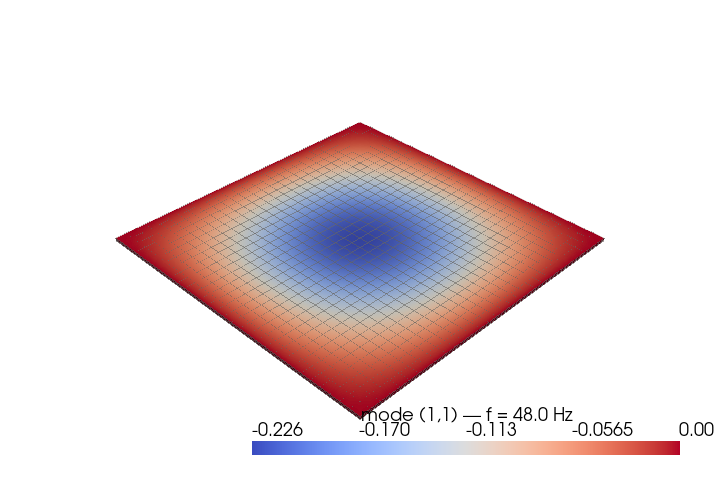
Render the (1, 1) bending mode shape#
phi = shapes[:, :, f11_idx]
warped = m.grid.copy()
warped.points = m.grid.points + (h / np.max(np.abs(phi)) * 0.4) * phi
warped["UZ"] = phi[:, 2]

plotter = pv.Plotter(off_screen=True, window_size=(720, 480))
plotter.add_mesh(
    m.grid,
    style="wireframe",
    color="grey",
    opacity=0.35,
    label="undeformed",
)
plotter.add_mesh(
    warped,
    scalars="UZ",
    cmap="coolwarm",
    show_edges=False,
    scalar_bar_args={"title": f"mode (1,1) — f = {f11_computed:.1f} Hz"},
)
plotter.view_isometric()
plotter.camera.zoom(1.05)
plotter.show()
Total running time of the script: (0 minutes 1.879 seconds)