Note
Go to the end to download the full example code.
Propped cantilever under uniformly-distributed load#
Statically-indeterminate first-order beam: clamped at \(x = 0\), simply supported at \(x = L\), with a uniform downward distributed load \(q\) over the full span. The closed-form Euler-Bernoulli solution (Roark & Young 1989, Table 8 case 7; Timoshenko 1955 §40) gives
and the maximum (downward) deflection occurs at \(x^{*} \approx 0.5785\, L\) with magnitude
Implementation#
Standard 3D BEAM2 (Hermite-cubic Bernoulli kinematics, Cook
Table 16.3-1) line of \(N_e = 20\) elements along the
span. Both end-section restraints use the native Model.fix()
API:
node 1 (clamp): all 6 DOFs pinned.
node \(N_e + 1\) (prop): UY = 0; out-of-plane DOFs (UZ, ROTX, ROTY, ROTZ) suppressed to keep the response purely in-plane.
The UDL is applied as the consistent nodal-force vector for a
uniform load on a Hermite beam (Cook §16.5,
\(\{f_e\} = q L_e \{1/2,\, L_e/12,\, 1/2,\, -L_e/12\}^{T}\)),
which is what an APDL F,FY,… over the line equivalents to.
References#
Timoshenko, S. P. (1955) Strength of Materials, Part I, 3rd ed., Van Nostrand, §40.
Roark, R. J. and Young, W. C. (1989) Roark’s Formulas for Stress and Strain, 6th ed., McGraw-Hill, Table 8 case 7.
Cook, R. D., Malkus, D. S., Plesha, M. E., Witt, R. J. (2002) Concepts and Applications of Finite Element Analysis, 4th ed., Wiley, §16.5 (consistent loads on beam elements).
from __future__ import annotations

import numpy as np
import pyvista as pv
from vtkmodules.util.vtkConstants import VTK_LINE

import femorph_solver
from femorph_solver import ELEMENTS
Problem data#
E = 2.0e11  # Pa (steel)
NU = 0.30
RHO = 7850.0  # kg/m^3
b = 0.050  # square cross-section side [m]
A = b * b
I = b**4 / 12.0  # second moment of area  # noqa: E741
J = 2.0 * I  # thin-square Saint-Venant J (no torsion in this BC set)
L = 1.0  # span [m]
q = 1.0e3  # uniform line load [N/m] (downward → -y)

N_ELEM = 20

# Closed-form quantities -----------------------------------------------

R_clamp_published = 5.0 / 8.0 * q * L
R_prop_published = 3.0 / 8.0 * q * L
M_clamp_published = q * L**2 / 8.0
delta_mid_published = q * L**4 / (192.0 * E * I)
delta_max_published = q * L**4 / (185.0 * E * I)
x_star = 0.5785  # location of max deflection / L

print(f"q = {q:.1f} N/m, L = {L:.2f} m, EI = {E * I:.3e} N m^2")
print(f"R_clamp  = 5/8 q L          = {R_clamp_published:.4f} N")
print(f"R_prop   = 3/8 q L          = {R_prop_published:.4f} N")
print(f"M_clamp  = 1/8 q L^2        = {M_clamp_published:.4f} N m")
print(f"δ(L/2)   = q L^4 / (192 EI) = {delta_mid_published:.4e} m")
print(f"δ_max    = q L^4 / (185 EI) = {delta_max_published:.4e} m  (at x ≈ {x_star} L)")
q = 1000.0 N/m, L = 1.00 m, EI = 1.042e+05 N m^2
R_clamp  = 5/8 q L          = 625.0000 N
R_prop   = 3/8 q L          = 375.0000 N
M_clamp  = 1/8 q L^2        = 125.0000 N m
δ(L/2)   = q L^4 / (192 EI) = 5.0000e-05 m
δ_max    = q L^4 / (185 EI) = 5.1892e-05 m  (at x ≈ 0.5785 L)
Build a 20-element BEAM2 line#
points = np.array(
    [[i * L / N_ELEM, 0.0, 0.0] for i in range(N_ELEM + 1)],
    dtype=np.float64,
)
cells_list: list[int] = []
for i in range(N_ELEM):
    cells_list.extend([2, i, i + 1])
cells = np.asarray(cells_list, dtype=np.int64)
cell_types = np.full(N_ELEM, VTK_LINE, dtype=np.uint8)
grid = pv.UnstructuredGrid(cells, cell_types, points)

m = femorph_solver.Model.from_grid(grid)
m.assign(
    ELEMENTS.BEAM2,
    material={"EX": E, "PRXY": NU, "DENS": RHO},
    real=(A, I, I, J),
)
Boundary conditions#
Node 1 — clamp (all 6 DOFs pinned). Node N_e + 1 — pin only UY (the prop) and suppress out-of-plane DOFs so the response is in the x-y plane.
m.fix(nodes=[1], dof="ALL")
prop = N_ELEM + 1
m.fix(nodes=[prop], dof="UY")
# Suppress out-of-plane / torsional DOFs so the response stays
# in the x-y plane.  ROTZ is **free** at the prop — pinning it
# would turn the simple support into a clamp and the problem
# would be a clamped-clamped beam (50/50 reaction split) instead
# of a propped cantilever (5/8 - 3/8 split).
m.fix(nodes=[prop], dof="UZ")
m.fix(nodes=[prop], dof="ROTX")
m.fix(nodes=[prop], dof="ROTY")
Consistent UDL on a Hermite beam#
For a single Bernoulli element of length \(L_e\) under uniform line load \(q\), the consistent nodal forces / moments at its two endpoints are
i.e. half the segment load goes to each endpoint as a transverse force, and a fixing moment of magnitude \(q L_e^{2}/12\) accumulates at each end with opposite signs (Cook §16.5). We assemble these onto the model nodes.
L_e = L / N_ELEM
fy_per_node = np.zeros(N_ELEM + 1)
mz_per_node = np.zeros(N_ELEM + 1)
for e in range(N_ELEM):
    f_half = -q * L_e / 2.0  # half of -q L_e per endpoint (downward)
    m_left = -q * L_e**2 / 12.0  # = -q L_e^2 / 12 from {-qL/2,-qL^2/12,-qL/2,+qL^2/12}
    m_right = +q * L_e**2 / 12.0
    fy_per_node[e] += f_half
    fy_per_node[e + 1] += f_half
    mz_per_node[e] += m_left
    mz_per_node[e + 1] += m_right

for i in range(N_ELEM + 1):
    if abs(fy_per_node[i]) > 0:
        m.apply_force(i + 1, fy=float(fy_per_node[i]))
    if abs(mz_per_node[i]) > 0:
        m.apply_force(i + 1, mz=float(mz_per_node[i]))
Static solve + reaction extraction#
res = m.solve()
dof = m.dof_map()


def _react(node: int, dof_idx: int) -> float:
    rows = np.where((dof[:, 0] == node) & (dof[:, 1] == dof_idx))[0]
    return float(res.reaction[rows[0]]) if len(rows) else 0.0


R_clamp_y = _react(1, 1)  # UY reaction at clamp
M_clamp_z = _react(1, 5)  # ROTZ reaction at clamp
R_prop_y = _react(prop, 1)  # UY reaction at prop

print()
print("reactions  (femorph-solver) → (analytical)")
print(f"  R_clamp_UY  = {R_clamp_y:+.4f}  →  {+R_clamp_published:+.4f} N")
print(f"  R_prop_UY   = {R_prop_y:+.4f}  →  {+R_prop_published:+.4f} N")
print(f"  M_clamp_RZ  = {M_clamp_z:+.4f}  →  {+M_clamp_published:+.4f} N m")
reactions  (femorph-solver) → (analytical)
  R_clamp_UY  = +625.0000  →  +625.0000 N
  R_prop_UY   = +375.0000  →  +375.0000 N
  M_clamp_RZ  = +125.0000  →  +125.0000 N m
Equilibrium check + tolerance assertions#
Sum of vertical reactions must balance the applied UDL (5/8 + 3/8 = 1) and the moment about the clamp from the downward load + prop reaction must be zero.
assert np.isclose(R_clamp_y + R_prop_y, q * L, rtol=1e-6), "vertical equilibrium failed"
assert np.isclose(R_clamp_y, R_clamp_published, rtol=1e-6), "clamp UY reaction off"
assert np.isclose(R_prop_y, R_prop_published, rtol=1e-6), "prop UY reaction off"
assert np.isclose(M_clamp_z, M_clamp_published, rtol=1e-6), "clamp moment off"
Mid-span deflection#
Hermite cubic bases recover Euler-Bernoulli kinematics exactly for prismatic beams under nodal loads, so the mid-span UY equals the analytical \(\delta(L/2) = q L^4 / (192 E I)\) to machine precision on a uniform mesh.
mid_node = N_ELEM // 2 + 1
mid_uy_val = float(res.displacement[np.where((dof[:, 0] == mid_node) & (dof[:, 1] == 1))[0][0]])
err_mid = (mid_uy_val - (-delta_mid_published)) / (-delta_mid_published)
print()
print(f"δ(L/2) computed   = {mid_uy_val:+.4e} m")
print(f"δ(L/2) published  = {-delta_mid_published:+.4e} m")
print(f"relative error    = {err_mid * 100:+.4f} %")
assert abs(err_mid) < 1.0e-4, "mid-span deflection error too large for Bernoulli BEAM2"
δ(L/2) computed   = -5.0000e-05 m
δ(L/2) published  = -5.0000e-05 m
relative error    = -0.0000 %
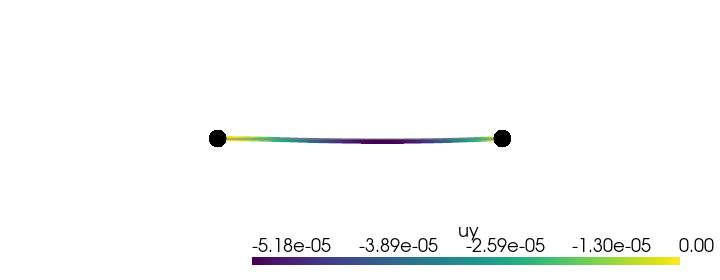
Render the deflected line#
pts = np.asarray(grid.points)
disp_y = np.zeros(N_ELEM + 1)
for i in range(N_ELEM + 1):
    rows = np.where((dof[:, 0] == i + 1) & (dof[:, 1] == 1))[0]
    if len(rows):
        disp_y[i] = float(res.displacement[rows[0]])
warped = grid.copy()
warped.points = pts + np.column_stack([np.zeros(N_ELEM + 1), 200.0 * disp_y, np.zeros(N_ELEM + 1)])
warped["uy"] = disp_y

plotter = pv.Plotter(off_screen=True, window_size=(720, 280))
plotter.add_mesh(grid, color="grey", line_width=2, opacity=0.5)
plotter.add_mesh(warped, scalars="uy", line_width=5, cmap="viridis")
plotter.add_points(
    np.array([[0.0, 0.0, 0.0], [L, 0.0, 0.0]]),
    render_points_as_spheres=True,
    point_size=18,
    color="black",
)
plotter.view_xy()
plotter.camera.zoom(1.05)
plotter.show()
Total running time of the script: (0 minutes 0.133 seconds)