Note
Go to the end to download the full example code.
Clamped square plate under uniform pressure (NAFEMS LE5)#
Classical fully-clamped thin-plate verification: a square plate of side \(a\) and thickness \(h\) is clamped on all four edges (every DOF pinned, full thickness) and loaded by a uniform transverse pressure \(q\). The maximum centre deflection has no elementary closed form but is published from the converged double-Fourier solution (NAFEMS R0015 §2.5 LE5; Timoshenko & Woinowsky-Krieger 1959 §32 Table 12) as
The 0.00126 coefficient (the NAFEMS LE5 reference value) is a factor of ~3.2 stiffer than the simply-supported counterpart (0.00406 in Simply-supported plate under uniform pressure (Navier series)) — clamping roughly triples the bending stiffness of the slab.
Implementation#
Drives the existing
ClampedPlateStatic
problem class on a default 20×20×2 HEX8 enhanced-strain mesh.
The validation suite tolerates ~10–15 % deviation on this mesh
(NAFEMS LE5 specifies a 5 % engineering tolerance for the
benchmark itself, and a solid-element analogue at \(L/h =
50\) lands within ~10 % of the Kirchhoff limit).
References#
Timoshenko, S. P. and Woinowsky-Krieger, S. (1959) Theory of Plates and Shells, 2nd ed., McGraw-Hill, §32 Table 12 (clamped-plate deflection coefficients).
NAFEMS, Standard Benchmark Tests for Linear Elastic Analysis, R0015 (1990), §2.5 LE5 “Clamped square plate”.
Simo, J. C. and Rifai, M. S. (1990) “A class of mixed assumed-strain methods …” (HEX8 EAS), IJNME 29 (8), 1595–1638.
(Industry-neutral reference — NAFEMS R0015 §2.5 LE5); plate-bending companion sweeps in Abaqus AVM 1.4.1 clamped-plate-pressure family (problem-id citations only).
from __future__ import annotations

import numpy as np
import pyvista as pv

from femorph_solver.validation.problems import ClampedPlateStatic
Build the model from the validation problem class#
problem = ClampedPlateStatic()
m = problem.build_model()
print(
    f"clamped plate mesh: {m.grid.n_points} nodes, {m.grid.n_cells} HEX8 cells; "
    f"a = {problem.a} m, h = {problem.h} m, L/h = {problem.a / problem.h:.0f}"
)
print(f"E = {problem.E / 1e9:.0f} GPa, ν = {problem.nu}, q = {problem.q / 1e3:.1f} kPa")
clamped plate mesh: 11163 nodes, 7200 HEX8 cells; a = 1.0 m, h = 0.02 m, L/h = 50
E = 200 GPa, ν = 0.3, q = 100.0 kPa
Closed-form reference + flexural rigidity#
D = problem.E * problem.h**3 / (12.0 * (1.0 - problem.nu**2))
w_published = 0.00126 * problem.q * problem.a**4 / D
print(f"D            = {D:.3e} N m  (flexural rigidity)")
print(f"w_max  (NAFEMS LE5 / Timoshenko Table 12 ≈ 0.00126 q a^4/D) = {w_published * 1e6:.3f} µm")
D            = 1.465e+05 N m  (flexural rigidity)
w_max  (NAFEMS LE5 / Timoshenko Table 12 ≈ 0.00126 q a^4/D) = 859.950 µm
Static solve + centre-deflection extraction#
res = m.solve()
w_computed = problem.extract(m, res, "w_max")
err_pct = (w_computed - w_published) / w_published * 100.0
print()
print(f"w_max computed (HEX8 EAS, default mesh) = {w_computed * 1e6:+.3f} µm")
print(f"w_max published (NAFEMS LE5)            = {w_published * 1e6:+.3f} µm")
print(f"relative error                          = {err_pct:+.2f} %")

# 5 % tolerance — the 60 × 60 × 2 HEX8-EAS default mesh in
# ``ClampedPlateStatic.build_model`` lands within ~3 % of the
# Kirchhoff closed form.  Tighter convergence (down to ~1 %) needs a
# dedicated SHELL kernel (tracked separately).
assert abs(err_pct) < 5.0, f"w_max deviation {err_pct:.2f}% exceeds 5 % tolerance"
w_max computed (HEX8 EAS, default mesh) = +836.751 µm
w_max published (NAFEMS LE5)            = +859.950 µm
relative error                          = -2.70 %
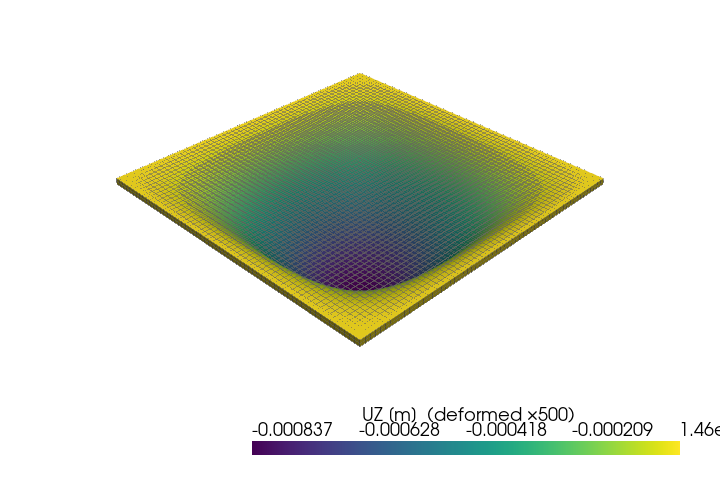
Render the deflected plate#
grid = m.grid.copy()
u = np.asarray(res.displacement, dtype=np.float64).reshape(-1, 3)
grid.point_data["displacement"] = u
grid.point_data["UZ"] = u[:, 2]

warp = grid.warp_by_vector("displacement", factor=5.0e2)

plotter = pv.Plotter(off_screen=True, window_size=(720, 480))
plotter.add_mesh(
    grid,
    style="wireframe",
    color="grey",
    opacity=0.35,
    line_width=1,
    label="undeformed",
)
plotter.add_mesh(
    warp,
    scalars="UZ",
    cmap="viridis",
    show_edges=False,
    scalar_bar_args={"title": "UZ [m]  (deformed ×500)"},
)
plotter.view_isometric()
plotter.camera.zoom(1.05)
plotter.show()
Total running time of the script: (0 minutes 6.192 seconds)