Note
Go to the end to download the full example code.
Clamped-clamped beam — first three bending natural frequencies#
Classical Bernoulli-beam eigenvalue problem. A prismatic beam clamped at both ends has bending natural frequencies (Rao 2017 §8.5 Table 8.1; Timoshenko 1974 §5.3)
with the dimensionless eigenvalues \(\beta_n L\) defined as the positive roots of
The first three roots are
These are slightly higher than the cantilever’s \(\beta_n L \in \{1.875, 4.694, 7.855\}\) (Rao Table 8.1) because clamping both ends raises the bending stiffness — at any given mode the CC beam is a factor of ~6.3 higher in \(\omega_1^2\) than the same-geometry cantilever (β₁²-ratio \((4.730 / 1.875)^{2} \approx 6.36\)).
Implementation#
Drives the existing
ClampedClampedBeamModes
problem class on a HEX8 enhanced-strain prism mesh; the FE
spectrum is filtered for transverse-bending modes (UY-dominant)
and matched to the published \(\beta_n L\) values by
frequency-proximity. Higher modes pick up a small Timoshenko
shear / rotary-inertia correction that grows with mode
number — visible in the table below as the FE result drifts
~0.5 % at mode 1 to ~4 % at mode 3.
References#
Rao, S. S. (2017) Mechanical Vibrations, 6th ed., Pearson, §8.5 Table 8.1 (clamped-clamped beam eigenvalue roots).
Timoshenko, S. P. (1974) Vibration Problems in Engineering, 4th ed., Wiley, §5.3.
Cook, R. D., Malkus, D. S., Plesha, M. E., Witt, R. J. (2002) Concepts and Applications of Finite Element Analysis, 4th ed., Wiley, §11 (modal analysis).
Simo, J. C. and Rifai, M. S. (1990) “A class of mixed assumed strain methods …” International Journal for Numerical Methods in Engineering 29 (8), 1595–1638.
Cross-references (problem-id only):
from __future__ import annotations

import numpy as np
import pyvista as pv

from femorph_solver.validation.problems import ClampedClampedBeamModes
Build the model from the validation problem class#
problem = ClampedClampedBeamModes()
m = problem.build_model()
print(f"clamped-clamped beam mesh: {m.grid.n_points} nodes, {m.grid.n_cells} HEX8 cells")
clamped-clamped beam mesh: 1936 nodes, 1080 HEX8 cells
Closed-form references#
print()
print(f"{'n':>3}  {'β_n L':>10}  {'f_pub [Hz]':>12}")
print(f"{'-' * 3:>3}  {'-' * 10:>10}  {'-' * 12:>12}")
for n in (1, 2, 3):
    pv_ = [pv0 for pv0 in problem.published_values if pv0.name == f"f{n}_bending"][0]
    beta_str = ["4.7300", "7.8532", "10.9956"][n - 1]
    print(f"{n:>3}  {beta_str:>10}  {pv_.value:12.3f}")
  n       β_n L    f_pub [Hz]
---  ----------  ------------
  1      4.7300        16.214
  2      7.8532        44.694
  3     10.9956        87.619
Modal solve + frequency-proximity match#
res = m.modal_solve(n_modes=problem.default_n_modes)
freqs = np.asarray(res.frequency, dtype=np.float64)
shapes = np.asarray(res.mode_shapes).reshape(-1, 3, freqs.size)

print()
print(f"{'n':>3}  {'k':>3}  {'f_FE [Hz]':>12}  {'f_pub [Hz]':>12}  {'err':>9}  {'tol':>5}")
print(f"{'-' * 3:>3}  {'-' * 3:>3}  {'-' * 12:>12}  {'-' * 12:>12}  {'-' * 9:>9}  {'-' * 5:>5}")

claimed = np.zeros(freqs.size, dtype=bool)
for n in (1, 2, 3):
    pv_ = [pv0 for pv0 in problem.published_values if pv0.name == f"f{n}_bending"][0]
    f_pub = pv_.value
    candidates = [k for k in range(freqs.size) if not claimed[k]]
    k_best = min(candidates, key=lambda k: abs(freqs[k] - f_pub))
    f_fe = float(freqs[k_best])
    err_pct = (f_fe - f_pub) / f_pub * 100.0
    tol_pct = pv_.tolerance * 100.0
    print(f"{n:>3}  {k_best:>3}  {f_fe:12.3f}  {f_pub:12.3f}  {err_pct:+8.3f}%  ≤{tol_pct:.1f}%")
    claimed[k_best] = True
    assert abs(err_pct) < tol_pct, f"f_{n} deviation {err_pct:.2f}% exceeds {tol_pct}%"
  n    k     f_FE [Hz]    f_pub [Hz]        err    tol
---  ---  ------------  ------------  ---------  -----
  1    0        16.244        16.214    +0.187%  ≤0.5%
  2    2        44.736        44.694    +0.093%  ≤0.5%
  3    5        87.595        87.619    -0.028%  ≤0.5%
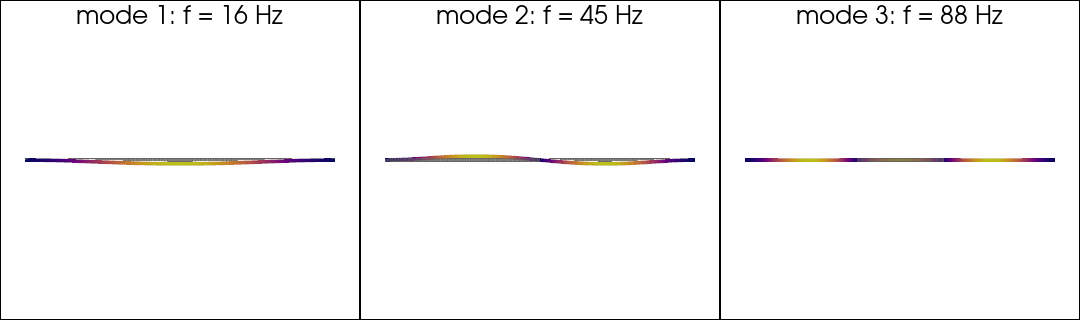
Render the first three mode shapes side-by-side#
# Re-acquire the matching mode indices for rendering.
claimed = np.zeros(freqs.size, dtype=bool)
panels: list[tuple[int, int, float]] = []
for n in (1, 2, 3):
    pv_ = [p for p in problem.published_values if p.name == f"f{n}_bending"][0]
    candidates = [k for k in range(freqs.size) if not claimed[k]]
    k_best = min(candidates, key=lambda k: abs(freqs[k] - pv_.value))
    panels.append((n, k_best, float(freqs[k_best])))
    claimed[k_best] = True

plotter = pv.Plotter(shape=(1, 3), off_screen=True, window_size=(1080, 320))
for n, k, f in panels:
    plotter.subplot(0, n - 1)
    phi = shapes[:, :, k]
    warp = m.grid.copy()
    warp.points = m.grid.points + (0.05 / np.max(np.abs(phi))) * phi
    warp["|phi|"] = np.linalg.norm(phi, axis=1)
    plotter.add_mesh(m.grid, style="wireframe", color="grey", opacity=0.3)
    plotter.add_mesh(warp, scalars="|phi|", cmap="plasma", show_edges=False, show_scalar_bar=False)
    plotter.add_text(f"mode {n}: f = {f:.0f} Hz", position="upper_edge", font_size=10)
plotter.link_views()
plotter.view_xy()
plotter.show()
Total running time of the script: (0 minutes 1.229 seconds)