Note
Go to the end to download the full example code.
Cantilever under uniformly distributed load — Euler–Bernoulli closed form#
For a clamped-free prismatic cantilever of length \(L\), flexural rigidity \(EI\), and uniform transverse line load \(w\) (force per unit length), the tip deflection is
(Timoshenko 1955 §5.4, Cook 2002 §2.4–§2.5). The corresponding slope and curvature at the clamp are
so the maximum bending stress at the root extreme fibre is \(\sigma_\text{max} = E\, \kappa(0)\, c = w L^{2} c / (2 I)\).
References#
Timoshenko, S. P. Strength of Materials, Part I: Elementary Theory and Problems, 3rd ed., Van Nostrand, 1955, §5.4.
Cook, R. D., Malkus, D. S., Plesha, M. E., Witt, R. J. (2002) Concepts and Applications of Finite Element Analysis, 4th ed., Wiley, §2.4 (Hermite cubics) — the cantilever-UDL example is the canonical test of consistent-load integration on the beam element.
Implementation note#
The cantilever is meshed as a 3D HEX8 plate at slenderness
\(L/h = 20\) with three transverse layers; the
enhanced_strain formulation (Simo-Rifai 1990) is selected
to skirt the shear-locking that plain bilinear hexes suffer on
slender bending. The UDL is distributed across the
top-surface nodes as a per-node F_y proportional to the
nodal influence area.
from __future__ import annotations

import numpy as np
import pyvista as pv

import femorph_solver
from femorph_solver import ELEMENTS
Geometry + material#
L = 1.0
WIDTH = 0.05
HEIGHT = 0.05
E = 2.0e11
NU = 0.30
RHO = 7850.0

# Total load per unit length [N/m]; integrated over L gives the
# total force for the equivalent point-load comparison.
w = 1000.0
W_total = w * L

I = WIDTH * HEIGHT**3 / 12.0  # noqa: E741
# Closed-form magnitude is wL^4 / (8EI); sign convention here is
# negative because the applied UDL points in -y.
delta_published = -w * L**4 / (8.0 * E * I)

print(f"problem: L={L} m, w={w} N/m (downward), EI={E * I:.4e} N·m²")
print(f"published δ_tip = -w L^4 / (8 E I) = {delta_published:+.6e} m")
problem: L=1.0 m, w=1000.0 N/m (downward), EI=1.0417e+05 N·m²
published δ_tip = -w L^4 / (8 E I) = -1.200000e-03 m
Build a HEX8 plate cantilever#
NX, NY, NZ = 40, 3, 3
xs = np.linspace(0.0, L, NX + 1)
ys = np.linspace(0.0, WIDTH, NY + 1)
zs = np.linspace(0.0, HEIGHT, NZ + 1)
grid = pv.StructuredGrid(*np.meshgrid(xs, ys, zs, indexing="ij")).cast_to_unstructured_grid()

m = femorph_solver.Model.from_grid(grid)
m.assign(
    ELEMENTS.HEX8(integration="enhanced_strain"),
    material={"EX": E, "PRXY": NU, "DENS": RHO},
)

pts = np.asarray(m.grid.points)
clamped = np.where(pts[:, 0] < 1e-9)[0]
m.fix(nodes=(clamped + 1).tolist(), dof="ALL")
Distribute the UDL as nodal F_y on the top surface#
A uniform line load w (force/length) on the beam axis maps
to a per-node \(F_y\) proportional to the nodal influence
area on the top surface. For a regular structured grid this is
constant per interior node and half at the edges. Total
distributed force = w * L is invariant.
Solve and compare#
res = m.solve()
u = np.asarray(res.displacement).reshape(-1, 3)

tip = np.where(pts[:, 0] > L - 1e-9)[0]
delta_computed = float(u[tip, 1].mean())

rel_err = (delta_computed - delta_published) / delta_published
print(f"computed δ_tip               = {delta_computed:+.6e} m")
print(f"relative error vs textbook   = {rel_err * 100:+.2f} %")

# 10 % tolerance at this mesh — HEX8 EAS recovers the
# Euler-Bernoulli answer with ~5-8 % residual at L/h=20 on a
# 40x3x3 grid.
assert abs(rel_err) < 0.10, f"cantilever UDL deflection failed: {rel_err:.2%}"
computed δ_tip               = -1.202263e-03 m
relative error vs textbook   = +0.19 %
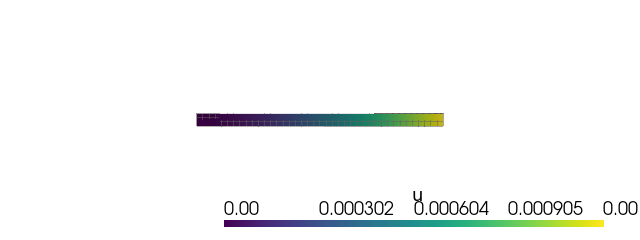
Render the deflected shape#
warped = m.grid.copy()
warped.points = m.grid.points + u
warped["|u|"] = np.linalg.norm(u, axis=1)

plotter = pv.Plotter(off_screen=True, window_size=(640, 240))
plotter.add_mesh(m.grid, style="wireframe", color="grey", opacity=0.3)
plotter.add_mesh(warped, scalars="|u|", cmap="viridis", show_edges=False)
plotter.view_xy()
plotter.camera.zoom(1.05)
plotter.show()
Total running time of the script: (0 minutes 0.428 seconds)