Note
Go to the end to download the full example code.
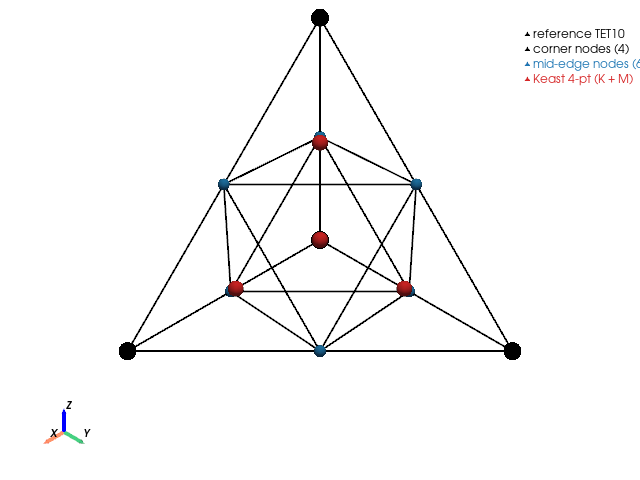
TET10 reference geometry — corner + mid-edge nodes, Keast points#
Renders the 10-node quadratic tetrahedron’s reference element \(\{(\xi_1, \xi_2, \xi_3) : \xi_i \ge 0, \sum_i \xi_i \le 1\}\):
4 corner nodes at the unit-tet vertices.
6 mid-edge nodes at the centre of every edge.
Keast (1986) 4-point quadrature rule used for both \(K^e\) and \(M^e\) — degree-2 exact, weights \(1/24\).
Shape functions (volume coordinates \(L_i\)):
for the four corners and six mid-edges respectively (Cook 2002 Table 6.5-1).
Keast 4-point rule on the unit tet:
References#
Keast, P. (1986) “Moderate-degree tetrahedral quadrature formulas,” Computer Methods in Applied Mechanics and Engineering 55, 339–348.
Cook, R. D., Malkus, D. S., Plesha, M. E., Witt, R. J. (2002) Concepts and Applications of Finite Element Analysis, 4th ed., Wiley, §9.2–§9.3.
Hughes, T. J. R. (2000) The Finite Element Method, Dover, §3.8.
Implementation: femorph_solver.elements.tet10.Tet10.
from __future__ import annotations

import numpy as np
import pyvista as pv
Node layout — 4 corners + 6 mid-edges#
corners = np.array(
    [
        [0.0, 0.0, 0.0],
        [1.0, 0.0, 0.0],
        [0.0, 1.0, 0.0],
        [0.0, 0.0, 1.0],
    ]
)
mid_edges = np.array(
    [
        # ordering matches VTK_QUADRATIC_TETRA: edges 0-1, 1-2, 2-0,
        # 0-3, 1-3, 2-3.
        0.5 * (corners[0] + corners[1]),
        0.5 * (corners[1] + corners[2]),
        0.5 * (corners[2] + corners[0]),
        0.5 * (corners[0] + corners[3]),
        0.5 * (corners[1] + corners[3]),
        0.5 * (corners[2] + corners[3]),
    ]
)
all_nodes = np.vstack([corners, mid_edges])

cells = np.hstack([[10], np.arange(10, dtype=np.int64)])
cell_types = np.array([pv.CellType.QUADRATIC_TETRA], dtype=np.uint8)
ref_tet = pv.UnstructuredGrid(cells, cell_types, all_nodes)
Keast 4-point integration points#
Render the figure#
plotter = pv.Plotter(off_screen=True, window_size=(640, 480))
plotter.add_mesh(
    ref_tet,
    style="wireframe",
    color="black",
    line_width=2,
    label="reference TET10",
)
plotter.add_points(
    corners,
    render_points_as_spheres=True,
    point_size=18,
    color="black",
    label="corner nodes (4)",
)
plotter.add_points(
    mid_edges,
    render_points_as_spheres=True,
    point_size=12,
    color="#1f77b4",
    label="mid-edge nodes (6)",
)
plotter.add_points(
    keast,
    render_points_as_spheres=True,
    point_size=16,
    color="#d62728",
    label="Keast 4-pt (K + M)",
)
plotter.add_axes(line_width=4, color="black")
plotter.view_isometric()
plotter.camera.zoom(1.1)
plotter.add_legend(face=None, size=(0.22, 0.14), bcolor="white")
plotter.show()
Sanity: Keast weights sum to the unit-tet volume = 1/6#
Keast 4-pt: Σ w_q = 0.166667; unit-tet volume = 0.166667. Match.
Verify the partition of unity at the Keast points#
L = np.column_stack([1.0 - keast.sum(axis=1), keast[:, 0], keast[:, 1], keast[:, 2]])
# Corner shape functions L_i (2 L_i - 1).
N_corner = L * (2.0 * L - 1.0)
# Mid-edge shape functions 4 L_i L_j over the 6 edges.
edge_pairs = [(0, 1), (1, 2), (2, 0), (0, 3), (1, 3), (2, 3)]
N_mid = np.column_stack([4.0 * L[:, i] * L[:, j] for i, j in edge_pairs])
sums = N_corner.sum(axis=1) + N_mid.sum(axis=1)
print("partition-of-unity Σ N_i at each Keast point:")
for q, s in zip(keast, sums, strict=True):
    print(f"  ξ₁={q[0]:+.4f}  ξ₂={q[1]:+.4f}  ξ₃={q[2]:+.4f}  Σ={s:.15f}")
np.testing.assert_allclose(sums, 1.0, atol=1.0e-14)
print("OK — all 10 shape functions sum to 1 at every Keast point.")
partition-of-unity Σ N_i at each Keast point:
  ξ₁=+0.5854  ξ₂=+0.1382  ξ₃=+0.1382  Σ=1.000000000000000
  ξ₁=+0.1382  ξ₂=+0.5854  ξ₃=+0.1382  Σ=1.000000000000000
  ξ₁=+0.1382  ξ₂=+0.1382  ξ₃=+0.5854  Σ=1.000000000000000
  ξ₁=+0.1382  ξ₂=+0.1382  ξ₃=+0.1382  Σ=1.000000000000000
OK — all 10 shape functions sum to 1 at every Keast point.
Total running time of the script: (0 minutes 0.204 seconds)