Note
Go to the end to download the full example code.
HEX20 — uniaxial tension on a 20-node hex#
Single HEX20 brick (a unit cube, 20 nodes including the mid-edge
nodes of the serendipity family) loaded in uniaxial tension. The
consistent-load vector for a serendipity 8-node face has corner weight
\(-1/12\) and mid-edge weight \(+1/3\); applying these produces
a uniform σxx field, so εxx = σ/E and εyy = εzz = −ν·εxx
exactly at every node.
from __future__ import annotations

import numpy as np
import pyvista as pv
from vtkmodules.util.vtkConstants import VTK_QUADRATIC_HEXAHEDRON

import femorph_solver
from femorph_solver import ELEMENTS
Reference 20-node unit cube#
Corners 1-8 in VTK_QUADRATIC_HEXAHEDRON order, then mid-edge nodes 9-20 on the bottom, top, and vertical edges.
E = 2.1e11  # Pa
NU = 0.30
F_TOTAL = 4.2e4  # N

coords = np.array(
    [
        [0.0, 0.0, 0.0],
        [1.0, 0.0, 0.0],
        [1.0, 1.0, 0.0],
        [0.0, 1.0, 0.0],
        [0.0, 0.0, 1.0],
        [1.0, 0.0, 1.0],
        [1.0, 1.0, 1.0],
        [0.0, 1.0, 1.0],
        [0.5, 0.0, 0.0],
        [1.0, 0.5, 0.0],
        [0.5, 1.0, 0.0],
        [0.0, 0.5, 0.0],
        [0.5, 0.0, 1.0],
        [1.0, 0.5, 1.0],
        [0.5, 1.0, 1.0],
        [0.0, 0.5, 1.0],
        [0.0, 0.0, 0.5],
        [1.0, 0.0, 0.5],
        [1.0, 1.0, 0.5],
        [0.0, 1.0, 0.5],
    ],
    dtype=np.float64,
)
Build the model#
cells = np.concatenate([[20], np.arange(20, dtype=np.int64)])
cell_types = np.array([VTK_QUADRATIC_HEXAHEDRON], dtype=np.uint8)
grid = pv.UnstructuredGrid(cells, cell_types, coords)

m = femorph_solver.Model.from_grid(grid)
m.assign(ELEMENTS.HEX20, material={"EX": E, "PRXY": NU})

# Symmetry BC: x=0 face UX, y=0 face UY, z=0 face UZ.
x0 = [1, 4, 5, 8, 12, 16, 17, 20]
y0 = [1, 2, 5, 6, 9, 13, 17, 18]
z0 = [1, 2, 3, 4, 9, 10, 11, 12]
for nn in x0:
    m.fix(nodes=[nn], dof="UX", value=0.0)
for nn in y0:
    m.fix(nodes=[nn], dof="UY", value=0.0)
for nn in z0:
    m.fix(nodes=[nn], dof="UZ", value=0.0)

# Consistent-load on x=1 face: 4 corners × −F/12 + 4 mid-edges × +F/3
# (integrates to F_TOTAL exactly for a uniform traction).
for nn in (2, 3, 6, 7):
    m.apply_force(nn, fx=-F_TOTAL / 12.0)
for nn in (10, 14, 18, 19):
    m.apply_force(nn, fx=F_TOTAL / 3.0)
Static solve and strain recovery#
res = m.solve()
eps = m.eel(res.displacement)

eps_xx_expected = F_TOTAL / E
eps_yy_expected = -NU * eps_xx_expected
print(f"εxx expected = {eps_xx_expected:.3e}  |  recovered (mean) = {eps[:, 0].mean():.3e}")
print(f"εyy expected = {eps_yy_expected:.3e}  |  recovered (mean) = {eps[:, 1].mean():.3e}")
εxx expected = 2.000e-07  |  recovered (mean) = 2.000e-07
εyy expected = -6.000e-08  |  recovered (mean) = -6.000e-08
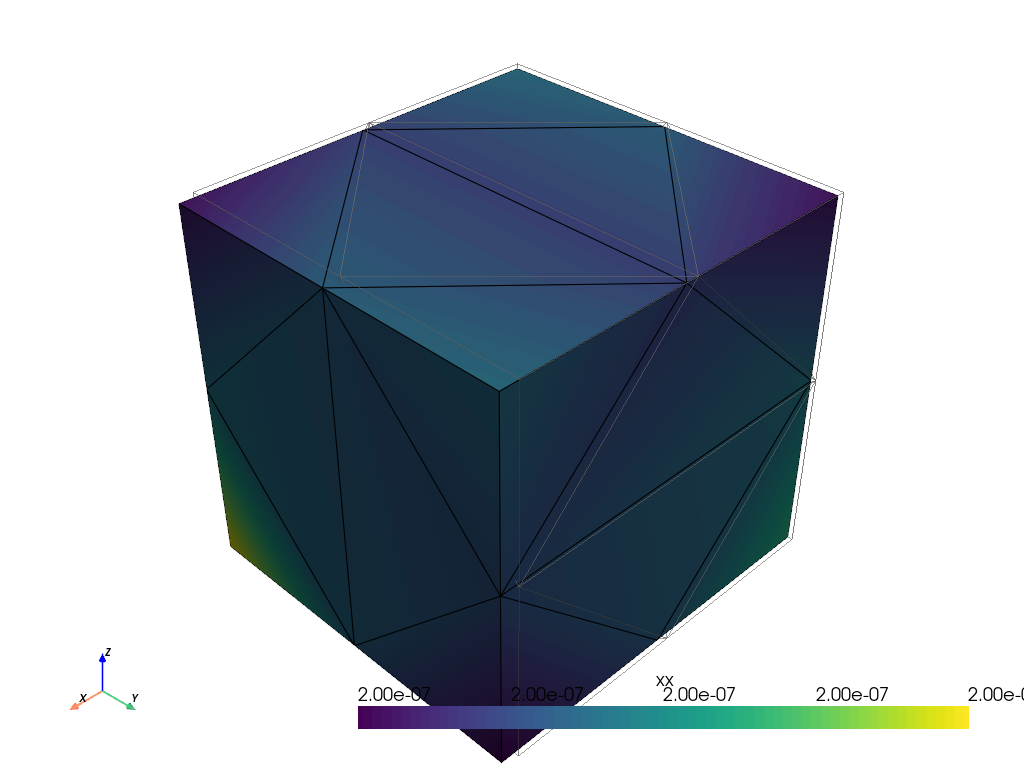
Plot the deformed cube, coloured by εxx#
grid = femorph_solver.io.static_result_to_grid(m, res)
node_nums = m.node_numbers
node_to_idx = {int(nn): i for i, nn in enumerate(node_nums)}
grid.point_data["eps_xx"] = np.array(
    [eps[node_to_idx[int(nn)], 0] for nn in grid.point_data["ansys_node_num"]]
)

plotter = pv.Plotter(off_screen=True)
plotter.add_mesh(grid, style="wireframe", color="gray", line_width=1, opacity=0.4)
plotter.add_mesh(
    grid.warp_by_vector("displacement", factor=2.0e5),
    scalars="eps_xx",
    show_edges=True,
    cmap="viridis",
    scalar_bar_args={"title": "εxx"},
)
plotter.add_axes()
plotter.show()
Total running time of the script: (0 minutes 0.251 seconds)