Note
Go to the end to download the full example code.
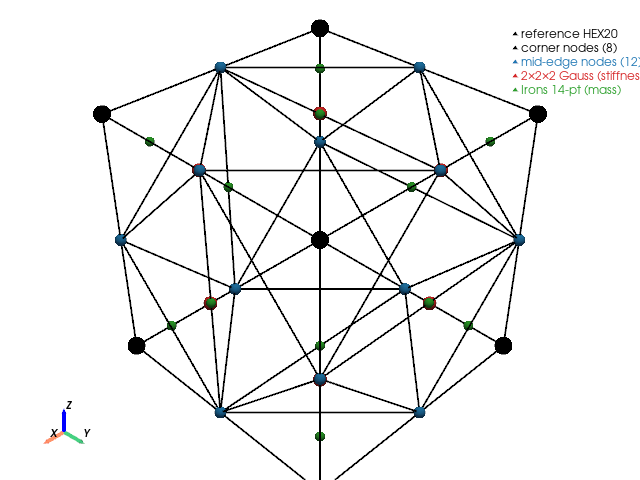
HEX20 reference geometry — corner + mid-edge nodes, Gauss points#
Renders the 20-node serendipity hexahedron’s reference element \(\hat\Omega = [-1, 1]^3\):
8 corner nodes at \((\xi, \eta, \zeta) \in \{-1, +1\}^3\).
12 mid-edge nodes at the centre of every cube edge.
14-point Irons (1971) quadrature points used for the consistent-mass integral on this kernel.
2×2×2 reduced-integration Gauss points \((\xi, \eta, \zeta) \in \{\pm 1/\sqrt{3}\}^3\) used for the stiffness integral by default in femorph-solver (the femorph-solver default for HEX20).
Shape functions#
The serendipity HEX20 basis (Hughes 2000 §3.7; Zienkiewicz & Taylor 2013 §6.6) splits the 20 nodal functions into corner and mid-edge groups:
with analogous expressions for the four mid-edges along each of \(\eta_j = 0\) and \(\zeta_j = 0\).
References#
Ergatoudis, J. G., Irons, B. M. and Zienkiewicz, O. C. (1968) “Curved isoparametric quadrilateral elements for finite element analysis,” International Journal of Solids and Structures 4 (1), 31–42 — original serendipity basis.
Hughes, T. J. R. (2000) The Finite Element Method, Dover, §3.7.
Irons, B. M. (1971) “Quadrature rules for brick based finite elements,” International Journal for Numerical Methods in Engineering 3 (2), 293–294 — 14-point degree-5 rule.
Zienkiewicz, O. C., Taylor, R. L. (2013) The Finite Element Method: Its Basis and Fundamentals, 7th ed., §8.7.3.
Implementation: femorph_solver.elements.hex20.Hex20.
from __future__ import annotations

import numpy as np
import pyvista as pv
Node layout#
8 corners + 12 mid-edges = 20 nodes. We label corner indices 0..7 and mid-edge indices 8..19 to match the standard isoparametric ordering used by VTK_QUADRATIC_HEXAHEDRON.
corners = np.array(
    [
        [-1, -1, -1],
        [+1, -1, -1],
        [+1, +1, -1],
        [-1, +1, -1],
        [-1, -1, +1],
        [+1, -1, +1],
        [+1, +1, +1],
        [-1, +1, +1],
    ],
    dtype=float,
)
mid_edges = np.array(
    [
        # bottom (z = -1) ring: 8, 9, 10, 11
        [0, -1, -1],
        [+1, 0, -1],
        [0, +1, -1],
        [-1, 0, -1],
        # top (z = +1) ring: 12, 13, 14, 15
        [0, -1, +1],
        [+1, 0, +1],
        [0, +1, +1],
        [-1, 0, +1],
        # vertical mid-edges (z = 0 ring): 16, 17, 18, 19
        [-1, -1, 0],
        [+1, -1, 0],
        [+1, +1, 0],
        [-1, +1, 0],
    ],
    dtype=float,
)
all_nodes = np.vstack([corners, mid_edges])

cells = np.hstack([[20], np.arange(20, dtype=np.int64)])
cell_types = np.array([pv.CellType.QUADRATIC_HEXAHEDRON], dtype=np.uint8)
ref_cube = pv.UnstructuredGrid(cells, cell_types, all_nodes)
Quadrature points — the two rules HEX20 uses#
# 2x2x2 Gauss-Legendre — stiffness (reduced).
g = 1.0 / np.sqrt(3.0)
gauss_8 = np.array(
    [(a, b, c) for a in (-g, +g) for b in (-g, +g) for c in (-g, +g)],
    dtype=float,
)

# Irons 14-point — consistent mass.  Six face-centre points at
# (±1, 0, 0), (0, ±1, 0), (0, 0, ±1) and 8 corner-octant points at
# ±sqrt(19/30)·(1, 1, 1) with sign permutations.
b_ = float(np.sqrt(19.0 / 30.0))
faces = np.array(
    [[+1, 0, 0], [-1, 0, 0], [0, +1, 0], [0, -1, 0], [0, 0, +1], [0, 0, -1]],
    dtype=float,
)
octants = np.array(
    [[a * b_, b * b_, c * b_] for a in (-1, +1) for b in (-1, +1) for c in (-1, +1)],
    dtype=float,
)
irons_14 = np.vstack([faces, octants])
Render#
plotter = pv.Plotter(off_screen=True, window_size=(640, 480))
plotter.add_mesh(
    ref_cube,
    style="wireframe",
    color="black",
    line_width=2,
    label="reference HEX20",
)
plotter.add_points(
    corners,
    render_points_as_spheres=True,
    point_size=18,
    color="black",
    label="corner nodes (8)",
)
plotter.add_points(
    mid_edges,
    render_points_as_spheres=True,
    point_size=12,
    color="#1f77b4",
    label="mid-edge nodes (12)",
)
plotter.add_points(
    gauss_8,
    render_points_as_spheres=True,
    point_size=14,
    color="#d62728",
    label="2×2×2 Gauss (stiffness)",
)
plotter.add_points(
    irons_14,
    render_points_as_spheres=True,
    point_size=10,
    color="#2ca02c",
    label="Irons 14-pt (mass)",
)
plotter.add_axes(line_width=4, color="black")
plotter.view_isometric()
plotter.camera.zoom(1.05)
plotter.add_legend(face=None, size=(0.24, 0.16), bcolor="white")
plotter.show()
Sanity: every Irons-14 point is inside \(\hat\Omega\)#
Irons 14-pt rule: 14 points, all inside [-1, 1]^3.
  6 face-centre points at ±1 along one axis
  8 corner-octant points at ±sqrt(19/30)·(1,1,1) sign-perm
Total running time of the script: (0 minutes 0.184 seconds)