Note
Go to the end to download the full example code.
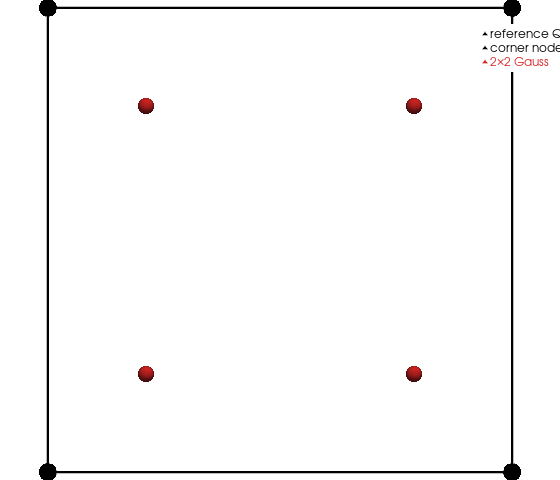
QUAD4 plane reference geometry — bilinear shape functions + 2×2 Gauss#
The 4-node bilinear plane element maps to the natural coordinates \((\xi, \eta) \in [-1, 1]^2\). Two translational DOFs per node; 8 DOFs per element.
Shape functions (bilinear Lagrange on the reference square):
with \((\xi_i, \eta_i) \in \{-1, +1\}^2\) at the corresponding corners. Stiffness and consistent mass use 2×2 Gauss-Legendre (4 points), exact for the bilinear \(B^T D B\) and \(N^T N\) integrands.
Plane stress vs plane strain selected by the _PLANE_MODE
material flag (Cook 2002 §3.5–§3.6).
References#
Zienkiewicz, O. C. and Taylor, R. L. (2013) The Finite Element Method, 7th ed., §6 + App. G.
Cook, R. D., Malkus, D. S., Plesha, M. E., Witt, R. J. (2002) Concepts and Applications of Finite Element Analysis, 4th ed., Wiley, §5, §11.3.
Hughes, T. J. R. (2000) The Finite Element Method, Dover, §3.1.
Implementation: femorph_solver.elements.quad4_plane.Quad4Plane.
from __future__ import annotations

import numpy as np
import pyvista as pv
Reference quad#
corners = np.array([[-1.0, -1.0, 0.0], [+1.0, -1.0, 0.0], [+1.0, +1.0, 0.0], [-1.0, +1.0, 0.0]])
cells = np.hstack([[4], np.arange(4, dtype=np.int64)])
cell_types = np.array([pv.CellType.QUAD], dtype=np.uint8)
ref_quad = pv.UnstructuredGrid(cells, cell_types, corners)
2×2 Gauss-Legendre on the reference square
Render
plotter = pv.Plotter(off_screen=True, window_size=(560, 480))
plotter.add_mesh(
    ref_quad, style="wireframe", color="black", line_width=2.5, label="reference QUAD4"
)
plotter.add_points(
    corners, render_points_as_spheres=True, point_size=18, color="black", label="corner nodes (4)"
)
plotter.add_points(
    gauss, render_points_as_spheres=True, point_size=16, color="#d62728", label="2×2 Gauss"
)
plotter.view_xy()
plotter.camera.zoom(1.4)
plotter.add_legend(face=None, size=(0.22, 0.10), bcolor="white")
plotter.show()
Verify partition of unity at the Gauss points#
xi_i = np.array([-1.0, +1.0, +1.0, -1.0])
eta_i = np.array([-1.0, -1.0, +1.0, +1.0])
sums = []
for q in gauss:
    s = sum(0.25 * (1 + xi_i[i] * q[0]) * (1 + eta_i[i] * q[1]) for i in range(4))
    sums.append(s)
sums = np.array(sums)
np.testing.assert_allclose(sums, 1.0, atol=1e-14)
print(f"4 Gauss points; Σ N_i(ξ_q, η_q) = {sums.round(15)} — partition of unity verified.")
4 Gauss points; Σ N_i(ξ_q, η_q) = [1. 1. 1. 1.] — partition of unity verified.
Total running time of the script: (0 minutes 0.168 seconds)