Note
Go to the end to download the full example code.
BEAM2 — cantilever tip deflection and first mode#
Slender steel cantilever modelled with a line of BEAM2 elements. Two validations:
Static tip deflection matches
P L³ / (3 E I)(Euler–Bernoulli).First natural frequency matches
(β₁ L)² √(E I / (ρ A L⁴))withβ₁ L = 1.87510407.
from __future__ import annotations

import numpy as np
import pyvista as pv
from vtkmodules.util.vtkConstants import VTK_LINE

import femorph_solver
from femorph_solver import ELEMENTS
Problem data#
Steel, square 50 × 50 mm section, 1 m span, 1 kN tip load.
Build the model#
BEAM2 has 6 DOFs per node; d(node, "ALL") on the clamped end
fixes all six. Hermite-cubic shape functions recover Euler–Bernoulli
exactly for prismatic beams, so 10 elements is already machine-precise
on the static answer.
points = np.array(
    [[i * L / N_ELEM, 0.0, 0.0] for i in range(N_ELEM + 1)],
    dtype=np.float64,
)
cells_list: list[int] = []
for i in range(N_ELEM):
    cells_list.extend([2, i, i + 1])
cells = np.asarray(cells_list, dtype=np.int64)
cell_types = np.full(N_ELEM, VTK_LINE, dtype=np.uint8)
grid = pv.UnstructuredGrid(cells, cell_types, points)

m = femorph_solver.Model.from_grid(grid)
m.assign(
    ELEMENTS.BEAM2,
    material={"EX": E, "PRXY": NU, "DENS": RHO},
    real=(A, I, I, J),
)

m.fix(nodes=[1], dof="ALL")  # fully clamp node 1
m.apply_force(N_ELEM + 1, fy=P)  # tip load in +y
Static solve + analytical comparison#
static = m.solve()
dof = m.dof_map()
tip_uy = np.where((dof[:, 0] == N_ELEM + 1) & (dof[:, 1] == 1))[0][0]
u_tip = static.displacement[tip_uy]
u_expected = P * L**3 / (3.0 * E * I)

print(f"BEAM2 tip UY       = {u_tip:.6e} m")
print(f"Analytical PL³/(3EI) = {u_expected:.6e} m")
assert np.isclose(u_tip, u_expected, rtol=1e-8)
BEAM2 tip UY       = 3.047619e-03 m
Analytical PL³/(3EI) = 3.047619e-03 m
Modal solve + analytical comparison#
The transverse DOFs in two planes give two (degenerate) first bending
modes. Because I_y = I_z here, femorph-solver’s eigensolver will return them
both at the same frequency.
modal = m.modal_solve(n_modes=4)
BETA_L = 1.87510407  # dimensionless cantilever eigenvalue (first mode)
omega_expected = BETA_L**2 * np.sqrt(E * I / (RHO * A * L**4))
omega1 = float(np.sqrt(modal.omega_sq[0]))
omega2 = float(np.sqrt(modal.omega_sq[1]))

print(f"Expected ω₁  = {omega_expected:.4f} rad/s")
print(f"Computed ω₁  = {omega1:.4f} rad/s")
print(f"Computed ω₂  = {omega2:.4f} rad/s (bending in the other plane)")
assert np.isclose(omega1, omega_expected, rtol=5e-3)
Expected ω₁  = 262.4853 rad/s
Computed ω₁  = 262.4855 rad/s
Computed ω₂  = 262.4855 rad/s (bending in the other plane)
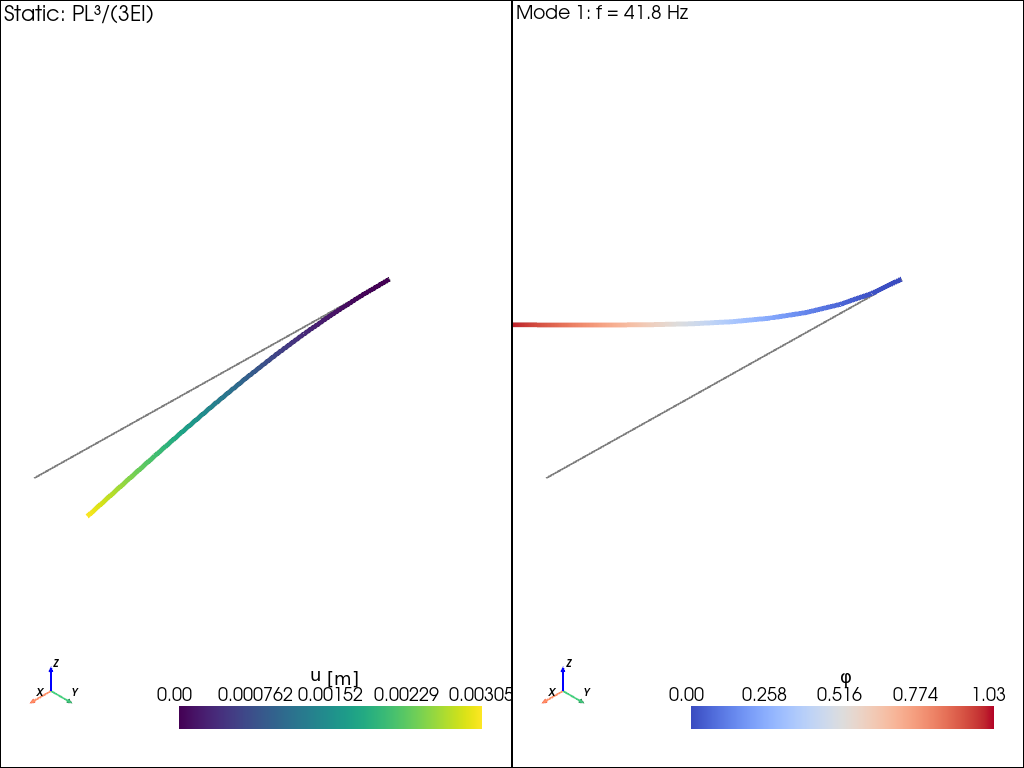
Plot the deflected shape and the first mode#
Scatter the static displacement onto the grid for visualisation, then overlay the first mode shape coloured by transverse amplitude.
grid = m.grid.copy()
disp = np.zeros((grid.n_points, 3), dtype=np.float64)
mode_disp = np.zeros_like(disp)
for i, nn in enumerate(grid.point_data["ansys_node_num"]):
    rows = np.where(dof[:, 0] == int(nn))[0]
    for r in rows:
        d_idx = int(dof[r, 1])
        if d_idx < 3:  # translations only for warping
            disp[i, d_idx] = static.displacement[r]
            mode_disp[i, d_idx] = modal.mode_shapes[r, 0]

# Scale mode to unit peak
peak = float(np.max(np.abs(mode_disp))) or 1.0
mode_disp /= peak

grid.point_data["static_disp"] = disp
grid.point_data["mode1_disp"] = mode_disp

plotter = pv.Plotter(shape=(1, 2), off_screen=True)
plotter.subplot(0, 0)
plotter.add_text("Static: PL³/(3EI)", font_size=10)
plotter.add_mesh(grid, style="wireframe", color="gray", line_width=2)
plotter.add_mesh(
    grid.warp_by_vector("static_disp", factor=50.0),
    scalars=np.linalg.norm(disp, axis=1),
    line_width=5,
    scalar_bar_args={"title": "|u| [m]"},
)
plotter.add_axes()

plotter.subplot(0, 1)
plotter.add_text(f"Mode 1: f = {modal.frequency[0]:.1f} Hz", font_size=10)
plotter.add_mesh(grid, style="wireframe", color="gray", line_width=2)
plotter.add_mesh(
    grid.warp_by_vector("mode1_disp", factor=0.3),
    scalars=np.linalg.norm(mode_disp, axis=1),
    line_width=5,
    cmap="coolwarm",
    scalar_bar_args={"title": "|φ|"},
)
plotter.add_axes()
plotter.link_views()
plotter.show()
Total running time of the script: (0 minutes 0.245 seconds)