Note
Go to the end to download the full example code.
Cyclic-symmetry modal sweep — annular disk#
A 12-sector annular disk has its global eigenspectrum factored
exactly by harmonic index \(k \in \{0, 1, \ldots, N/2\}\)
(Thomas 1979, Wildheim 1979). Each \(k\) produces a
reduced complex-Hermitian eigenproblem on a single base sector;
femorph-solver solves the real-symmetric 2n-augmentation form
(Grimes, Lewis & Simon 1994) so scipy.sparse.linalg.eigsh()
can return mode pairs at every harmonic.
This example builds a 12-sector disk, runs
Model.cyclic_modal_solve() over every harmonic, and prints
the lowest non-rigid frequency for each — illustrating how the
harmonic sweep recovers the full free-vibration spectrum at
\(1 / N\) the DOF count of an explicit full-rotor model.
References#
Thomas, D. L. (1979) “Dynamics of rotationally periodic structures,” Journal of Sound and Vibration 66 (4), 585–597.
Wildheim, S. J. (1979) “Excitation of rotationally periodic structures,” Journal of Applied Mechanics 46, 891–893.
Grimes, R. G., Lewis, J. G. and Simon, H. D. (1994) “A shifted block Lanczos algorithm for solving sparse symmetric generalized eigenproblems,” SIAM J. Matrix Analysis and Applications 15, 228–272 (real 2n augmentation for the complex-Hermitian sub-problem).
Bathe, K.-J. (2014) Finite Element Procedures, 2nd ed., §10.3.4 (cyclic-symmetry modal analysis).
from __future__ import annotations

import numpy as np
import pyvista as pv

import femorph_solver
from femorph_solver import ELEMENTS
Geometry — one base sector of a 12-sector annular disk#
Build the base sector mesh#
theta = np.linspace(0.0, ALPHA, N_T + 1)
r = np.linspace(R_INNER, R_OUTER, N_R + 1)
z = np.linspace(0.0, T_DISK, N_Z + 1)
R, T, Z = np.meshgrid(r, theta, z, indexing="ij")
X = R * np.cos(T)
Y = R * np.sin(T)

grid = pv.StructuredGrid(X, Y, Z).cast_to_unstructured_grid()
print(f"sector mesh: {grid.n_points} nodes, {grid.n_cells} HEX8 cells")
print(f"full-rotor equivalent: {N_SECTORS * grid.n_points} nodes")
sector mesh: 70 nodes, 24 HEX8 cells
full-rotor equivalent: 840 nodes
Wrap as a Model with steel material#
Identify low / high cyclic-face nodes by angular position#
The base sector spans \(\theta \in [0, \alpha]\). Nodes at \(\theta = 0\) form the low face; nodes at \(\theta = \alpha\) form the high face.
pts = np.asarray(grid.points)
node_nums = np.asarray(grid.point_data["ansys_node_num"], dtype=np.int64)
angle = np.arctan2(pts[:, 1], pts[:, 0])
tol = 1e-6
low_mask = np.abs(angle) < tol
high_mask = np.abs(angle - ALPHA) < tol
low_nodes = node_nums[low_mask]
high_nodes = node_nums[high_mask]

# Pair the two faces by (radius, z) coordinates so the cyclic
# constraint links matching points across the sector boundary.
low_pts = pts[low_mask]
high_pts = pts[high_mask]
low_radii_z = np.column_stack([np.linalg.norm(low_pts[:, :2], axis=1), low_pts[:, 2]])
high_radii_z = np.column_stack([np.linalg.norm(high_pts[:, :2], axis=1), high_pts[:, 2]])
order_low = np.lexsort(low_radii_z.T[::-1])
order_high = np.lexsort(high_radii_z.T[::-1])
low_nodes_paired = low_nodes[order_low]
high_nodes_paired = high_nodes[order_high]
print(f"cyclic faces: {len(low_nodes_paired)} paired nodes per face")
cyclic faces: 10 paired nodes per face
Run the harmonic sweep#
Solve the cyclic-symmetry modal problem on the base sector
at every harmonic \(k = 0, 1, \ldots, N/2\). Each
CyclicModalResult carries the lowest n_modes
eigenvalues for that harmonic.
n_modes = 8
results = m.cyclic_modal_solve(
    low_face=low_nodes_paired,
    high_face=high_nodes_paired,
    n_sectors=N_SECTORS,
    n_modes=n_modes,
)
Tabulate the lowest non-rigid frequency at each harmonic#
print()
print(f"{'k':>3}  {'f_min [Hz]':>12}  {'mode shape':>16}")
print(f"{'-':>3}  {'-' * 12:>12}  {'-' * 16:>16}")
for r_k in results:
    freqs = np.asarray(r_k.frequency, dtype=np.float64)
    # Discard rigid-body modes (f < 1 Hz) and report the lowest
    # bending-like frequency instead.
    elastic = freqs[freqs > 1.0]
    f_min = float(elastic[0]) if elastic.size else float("nan")
    mode_kind = "rigid (k=0)" if r_k.harmonic_index == 0 else f"k={r_k.harmonic_index} pair"
    print(f"{r_k.harmonic_index:>3}  {f_min:12.2f}  {mode_kind:>16}")
k    f_min [Hz]        mode shape
-  ------------  ----------------
0        328.21       rigid (k=0)
1        438.02          k=1 pair
2         76.12          k=2 pair
3        218.20          k=3 pair
4        421.23          k=4 pair
5        684.49          k=5 pair
6       1008.36          k=6 pair
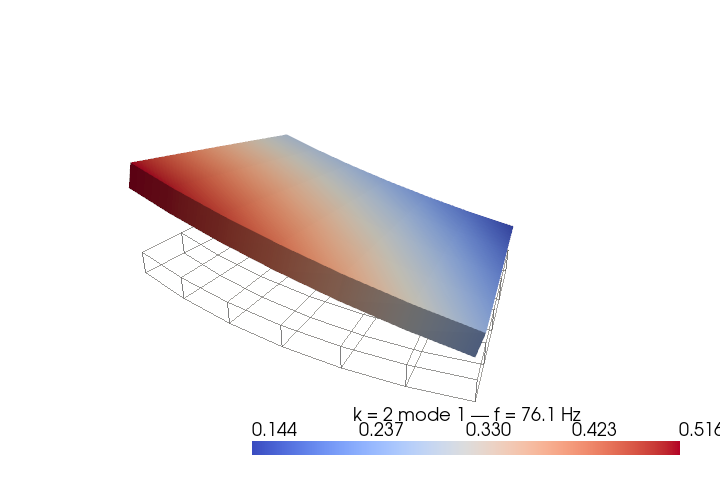
Render the lowest non-rigid mode at the most interesting harmonic#
k = 2 typically yields the lowest non-rigid mode on an annular disk — the classical “diametrical-2” pattern with two stationary radial nodes on the disc’s rim.
target_k = 2
chosen = next((r for r in results if r.harmonic_index == target_k), results[1])
phi = np.asarray(chosen.mode_shapes)[:, 0].reshape(-1, 3)
# k > 0 mode shapes are complex; take the real part for the
# stationary snapshot.  The travelling-wave companion lives in
# the imaginary part — see example_cyclic_modes_bladed_rotor.py.
phi_real = np.real(phi)
warp = grid.copy()
warp.points = grid.points + (T_DISK * 4.0 / np.max(np.abs(phi_real))) * phi_real
warp["UZ"] = phi_real[:, 2]

f_chosen = float(np.asarray(chosen.frequency)[0])
plotter = pv.Plotter(off_screen=True, window_size=(720, 480))
plotter.add_mesh(grid, style="wireframe", color="grey", opacity=0.4)
plotter.add_mesh(
    warp,
    scalars="UZ",
    cmap="coolwarm",
    show_edges=False,
    scalar_bar_args={"title": f"k = {chosen.harmonic_index} mode 1 — f = {f_chosen:.1f} Hz"},
)
plotter.view_isometric()
plotter.camera.zoom(1.05)
plotter.show()
Total running time of the script: (0 minutes 0.357 seconds)