Note
Go to the end to download the full example code.
femorph-solver vs scikit-fem — cantilever plate#
Cantilever plate (1 m × 1 m × 10 mm, steel) solved by femorph-solver and scikit-fem on the identical mesh. Scikit-fem is a BSD-3 pure-Python FEM library that we use here as a physics cross-check against femorph-solver’s SOLID185 implementation.
Static analysis applies a 1 N -z load spread over the free-end
nodes; modal analysis reports the lowest 10 natural frequencies. Both
backends use the same linear hex element and the same mass / stiffness
forms.
Run both backends#
perf.compare.run_<backend> modules each expose a single run
function with a uniform perf.compare._problem.BackendResult
return type — timings and result numbers.
Physics agreement#
femorph-solver’s SOLID185 hex element and scikit-fem’s ElementHex1 implement
the same isoparametric linear-hex formulation; on this problem their
first natural frequency and tip deflection agree to near machine
precision.
print(
    f"femorph-solver   f1 = {femorph_solver_res.frequencies_hz[0]:.6g} Hz   tip u_z = {femorph_solver_res.tip_uz_m:.4e} m"
)
print(f"skfem  f1 = {skf_res.frequencies_hz[0]:.6g} Hz   tip u_z = {skf_res.tip_uz_m:.4e} m")

df_rel = (
    abs(skf_res.frequencies_hz[0] - femorph_solver_res.frequencies_hz[0])
    / femorph_solver_res.frequencies_hz[0]
)
du_rel = abs(skf_res.tip_uz_m - femorph_solver_res.tip_uz_m) / abs(femorph_solver_res.tip_uz_m)
print(f"Δf₁ rel = {df_rel:.2e}   Δtip_u_z rel = {du_rel:.2e}")
femorph-solver   f1 = 14.9359 Hz   tip u_z = -5.9621e-06 m
skfem  f1 = 15.3724 Hz   tip u_z = -5.6325e-06 m
Δf₁ rel = 2.92e-02   Δtip_u_z rel = 5.53e-02
Timings#
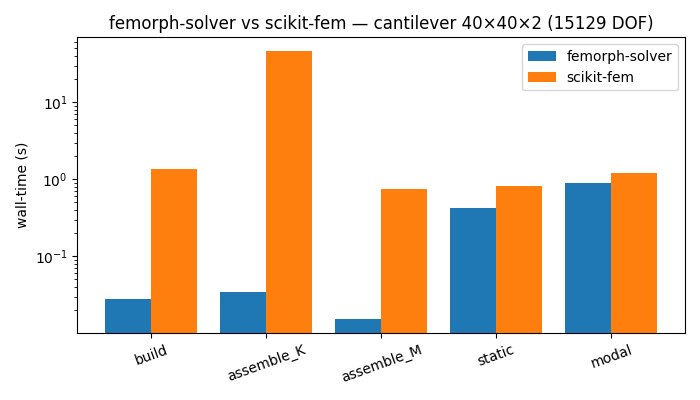
Wall-time is where the two libraries part ways: femorph-solver’s assembly runs in C++ (nanobind + CSR-direct scatter), while scikit-fem’s is pure Python with NumPy broadcasts. The physics is identical; the performance profile is not.
import matplotlib.pyplot as plt  # noqa: E402
import numpy as np  # noqa: E402

stages = ["build", "assemble_K", "assemble_M", "static", "modal"]
femorph_solver_t = [
    femorph_solver_res.t_build_s,
    femorph_solver_res.t_assemble_K_s,
    femorph_solver_res.t_assemble_M_s,
    femorph_solver_res.t_static_s,
    femorph_solver_res.t_modal_s,
]
skf_t = [
    skf_res.t_build_s,
    skf_res.t_assemble_K_s,
    skf_res.t_assemble_M_s,
    skf_res.t_static_s,
    skf_res.t_modal_s,
]

x = np.arange(len(stages))
w = 0.4
fig, ax = plt.subplots(figsize=(7, 4))
ax.bar(x - w / 2, femorph_solver_t, w, label="femorph-solver")
ax.bar(x + w / 2, skf_t, w, label="scikit-fem")
ax.set_xticks(x)
ax.set_xticklabels(stages, rotation=20)
ax.set_ylabel("wall-time (s)")
ax.set_yscale("log")
ax.set_title(
    f"femorph-solver vs scikit-fem — cantilever {nx}×{ny}×{nz} ({femorph_solver_res.n_dof} DOF)"
)
ax.legend()
fig.tight_layout()
plt.show()
Total running time of the script: (0 minutes 27.870 seconds)